With nearly 30 years of war in its recent history, determining who deserves veteran benefits is proving a contentious political issue.
By Daniel Plaut
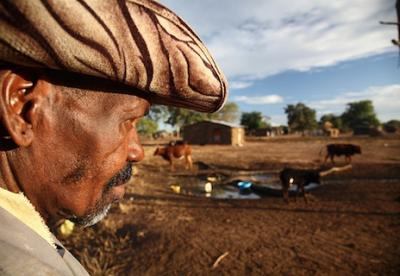
A farmer tending to his cows in Chokwe, Mozambique. Photograph by ILRI.
Nearly 20 years after the end of Mozambique’s civil war, debate about ex-combatant pensions and benefits are still heated in the capital Maputo. The discussion has centred on defining who counts as a ‘veteran’, which in a country that faced two devastating wars over the course of 30 years is a far from easy task.
The Statute of Veterans, passed in May 2011, is the latest attempt by the government to solve this dilemma and provide benefits to those who deserve them. What has developed is not a dichotomy of ex-combatant versus civilian, but instead a continuum of veteran-hood. Entitlement to benefits depends on which war a combatant participated in, for how long, and with which armed group.
Under the statute, veterans of Mozambique’s FRELIMO-led liberation war against Portugal (1964-75) are to receive a new “participation bonus” on top of their already existing minimum wage pensions. Veterans of Mozambique’s 16-year civil war (1977-92), however, are only offered a “social re-insertion bonus”, as long as they served for three years or more. This bonus is offered to both veterans from FRELIMO – the country’s ruling socialist party since independence in 1975 – or RENAMO – the country’s political opposition party, but what was initially a militant rebel group funded by Rhodesia (now Zimbabwe) then apartheid South Africa.
Missing links?
While providing unprecedented benefits to combatants of both wars, the statute has been opposed strongly by RENAMO representatives who claim it discriminates against their ex-combatants by providing higher benefits to FRELIMO fighters who fought in Mozambique’s liberation war.
More controversially, RENAMO has opposed the statute provision that means only years of fighting after an ex-combatant’s 14th birthday count. This suggests that, contrary to RENAMO’s previous assertions, the group recruited fighters younger than 14.
RENAMO’s cries of exclusion, however, have not been the only or even the loudest within the debate. After the statute was passed, much of the discourse has been pushed by Herminio dos Santos, president of the National Forum of Demobilised Soldiers (Fórum dos Desmobilizados de Guerra de Moçambique), who has campaigned for higher pensions and a broader definition of those entitled to veteran benefits.
Dos Santos has led several protests in Maputo and has been detained by police just as often. One of his main points of contention with the benefit scheme is the exclusion of peasant militia fighters, known as Naparamas, who fought alongside the government army against RENAMO. While they were never officially accounted for, activists claim there are nearly 22,000 of these ex-combatants being ignored by the government.
Fruitless negotiations
On March 12, Herminio dos Santos and his supporters were finally able to meet with Mateus Kida, Minister for Veteran Affairs, to discuss potential improvements to the veteran benefit system. In addition to the recognition of Naparamas as veterans, Dos Santos pushed for an overall increase in pensions to all ex-combatants to around 12,000 meticals a month ($440), nearly 6 times the national minimum wage set for agricultural workers.
These and other requests were dismissed by Minister Kida, who claimed he would not have agreed to the meeting were he previously aware of them. 14 other demobilised associations also distanced themselves from the proposals and have backed away from Dos Santos’ attempts to engender a redefinition of veterans through demonstrations.
Successful reintegration?
The fervent debate around ex-combatant benefits over the past few years questions the success of Mozambique’s reintegration process twenty years ago, which had heavy international involvement and was widely regarded as exemplary.
While it may seem farfetched to link the current debate on veteran benefits to reintegration programmes that started two decades ago, their impact has undoubtedly shaped today’s discourse. Like the recent statute, for example, the reintegration programmes excluded the thousands of militia fighters Herminio Dos Santos is now representing.
Widely funded and composed of varying initiatives and methods of reintegration, Mozambique’s security reform was widely declared a success in that it prevented a large-scale return to violence after the 1992 peace agreement. However, in doing so, it arguably retained more of a ‘negative peace’ in which wide-scale violence was absent, as opposed to ‘positive peace’ with reconciliation and prosperity.
Critics of the Mozambique’s reintegration argue that the reintegration programmes often made problematic assumptions regarding ex-combatants, including their socio-economic backgrounds and abilities. One UN programme, for example, assumed the average soldier came from a rural lifestyle and was aimed at giving ex-combatants tools to return to their supposedly peasant origins. The scheme was, at best, insufficient in supporting those that did want to pursue agriculture and, at worse, insulting to those whose other relevant skills were ignored.
Certain other programmes assumed the average soldier was a blank slate and could be made into a semi-skilled worker quickly to find employment. Underestimating existing economic structures, and overestimating the market available for semi-skilled workers, these programmes, while successful in preventing return to violence, were arguably inefficient in providing long-term solutions to ex-combatants.
Future of inequality
Another key dimension to the debate on who deserves veteran benefits is Mozambique’s recent spurt of significant yet unequal economic growth. Largely fuelled by offshore petroleum as well as the discovery of large natural gas fields, Mozambique’s GDP grew by 7% in 2011.
While the incoming revenue from these resources is welcome, the capital-intensive nature of these industries means that the job opportunities it creates are highly technical and likely to be filled in by foreign investing corporations.
This inequality of growth seems to be driving some of the rhetoric for better veteran benefits. An article from Mozambique’s newspaper Verdade highlighted this aspect of the debate when it pointed to the symbolism of government officials leaving a large protest of demobilised soldiers last October in their luxury cars as if nothing happened.
Political definitions
Seeking to overcome this issue, President Armando Guebuza has stated that while veteran pensions are significant, they will not bring significant improvement to Mozambique’s economic struggles. He argues that the focus should not be on dependency through pensions, but instead on working to “overcome poverty.”
With FRELIMO facing increasing opposition from the rising MDM party (Movimento Democratico de Moçambique) in addition to long-term opponent RENAMO, veteran benefits are likely to continue to be a hot political issue. This is particularly the case considering FRELIMO’s struggles in capturing the support of young people and its fading image as the country’s liberator.
It seems that even after twenty years of relative peace, Mozambique’s struggle to redefine itself politically and economically still hinges strongly on its history of war.
Democracy beyond the ballot box has been hard to come by for millions of Malians.
By Brandon County, Brian Peterson
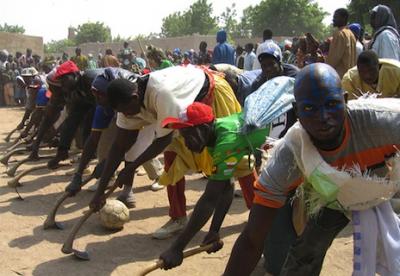
Hoe down: Malian farmers performing a traditional hoe dance. Photograph by Lisa Goldman.
What does it mean when civil society groups in rural southern Mali like the Syndicate of Peasants of Mali announce their support for the military junta, and its National Committee for Recovering Democracy and Restoring the State (CNRDR)?
The peasants’ syndicate, with their motto of “Land, Work, Dignity,” has asked the junta to pursue four goals: restore the ideals of 1991’s pro-democracy movement; manage the crisis in the country’s north; fight corruption; and work to restore expropriated lands.
These are risky moves in a time of political uncertainty and near-empty granaries. But such recent announcements, among others, in support of the military coup in Mali speak to the fragile economic situation that has developed alongside the country’s robust electoral system.
Thus, when examining Mali’s current political crisis, we must carefully consider how ordinary Malians view the privatisation of their lands, resources, and public companies by foreign enterprises. Indeed, unchecked neoliberal economic policies imposed from without threaten the viability of sustainable democratic institutions and the very social fabric that makes democracy work in the first place.
The coup may not have been caused by a rising tide of discontent, but it helps explain why some Malians, who have been steadfast supporters of democracy, now not only tolerate the military junta, but support it.
To be clear, acknowledging peasant and worker grievances does not excuse the putschists for their grievous error of expressing dissatisfaction through mutiny and, however inadvertently, overthrowing the democratically elected Amadou Toumani Touré (known popularly as ATT). Despite ATT’s many perceived failings and unpopularity, he was still the constitutional representative of the will of the people. Legitimacy via the ballot box trumps any ex post facto legitimacy that the CNRDR might have accrued after their coup d’état.
As some observers have astutely noted, the coup was “accidental”; and the junta has conducted itself in a makeshift manner. But whether publicly pro- or anti-coup, the consensus among Malians is that ATT is no longer welcome at the Presidential Palace and the country should return to a civilian government once Mali has been reunified and the northern rebellion has been ended. As protesters in Bamako chant: “Peace first, then elections.”
Cottoning on to concerns?
Not too long ago, Mali was the darling of the aid community and a leader within ECOWAS (Economic Community of West African States), lauded for its stable democracy. Burdened with crippling debt after 22 years of rule by a clique of military men, it worked with the World Bank and IMF.
In recent years though, we have witnessed a transformation of the Malian economy to the benefit of foreign capital and private interests, but ultimately to the detriment of Malian peasants and workers. Much of this hasn’t made the news, and much of it has been deliberately hidden from public scrutiny. ATT’s government engaged in secretive deals at a time when Malians were growing weary of corruption and the deteriorating economic situation.
Mali is overwhelmingly a peasant society, and cotton is the backbone of the Malian economy. In fact, cotton – together with livestock and gold – accounts for up to 90% of the country’s export revenues. The Malian Company for the Development Textiles (CMDT) buys peasants’ “white gold” and sells it abroad. But even when the CMDT pays on time, which has been a big issue for farmers, its cotton prices have remained low in order to be competitive in the unequal world market.
But changes are occurring in cotton production in Mali. In August 2008, Mali’s legislature voted to fully privatise the CMDT. In 2010, the Malian government divided the CMDT into four subsidiaries and offered them up for privatisation. And in December 2011, a Chinese company, the Yuemei Group, which already owns cotton fields and garment plants elsewhere in Africa, agreed to buy two of the subsidiaries.
Peasants mobilised against these changes. In fact, just one month ago, the aforementioned Syndicate of Peasants of Mali, and more than 600 peasants, met in Koutiala to express their concerns about privatisation and related agricultural policies. Furthermore, in recent years, many farmers have shifted their agricultural strategies to focus on grain production, which at least offers a measure of food security.
Landing issues
Beyond concerns over cotton pricing and agricultural inputs, access to land is under threat. Across the continent and decades after independence, de facto recognition of communal tenure systems is giving way to de jure state ownership, allowing for further privatisation of farmland, especially with the leasing of productive farmland to Libya and soil-poor but cash-rich Gulf states.
These developments have similarly sparked broad-based resistance. In November 2011, Malian peasants converged on the southern village of Nyéléni to protest land sales to foreign interests. Other participants came from 30 different countries, speaking to the international nature of the threat of land grabs.
At the conference, Ibrahim Coulibaly of the National Confederation of Peasant Organisations emphasised the human costs: “We have seen an increase in land grabbing…. But these lands are not empty! People may not have legal titles, but they have been there for generations, even centuries.”
Recent reports suggest that by December 2010, the government in Bamako had negotiated the lease of 544,500 hectares of Malian land to just 22 foreign investment firms, with 40% of the land targeted for the production of biofuel. These lands could otherwise support the livelihoods of half a million smallholder farmers.
Furthermore, shifting land away from food production threatens the country’s goal of agricultural self-sufficiency and, in the wake of the 2007-2008 food price crisis, it also threatens the urban food markets that rely on the countryside.
Aside from land and farming, runaway privatisation has made inroads into other sectors of the economy: the railroad, the telecommunications company, utilities, gold mines, and vegetable oil factories are controlled by private stakeholders with a penchant for cost-cutting, producing stagnant wages, discontent, layoffs, and protests. But the government has ignored workers’ voices, and labour leaders have been dismissed and even imprisoned.
Democracy, the d-word
Far beyond ATT’s incompetence in dealing with the northern insurgency, widespread discontent has grown in both urban and rural areas as people have come to believe that their role in the democratic process is limited to casting ballots every few years.
While outside observers are keen to understand – and measure – Malian democracy through elections, reforms imposed from the outside and implemented by elected governments have made democracy beyond elections, a less representative practice and – disturbingly – sometimes an unpopular term.
While Malians are proud of their elections, which they see as indigenous expressions of cooperation, tolerance, consensus-building, and decentralised governance, they also acknowledge that maintaining democracy is messy and difficult, particularly as the economic situation and the moral state of the elected government test their patience.
Thus, the crisis of Malian democracy was not solely the result of an accidental coup, drought, or separatist wars. Still, it is no secret that Mali’s democracy was in crisis long before the coup. A firm Malian belief in recognisable justice and democratic participation drives today’s critiques of ATT and the CNRDR and must be taken seriously when debating the future of Malian democracy.
What motivated Mali’s unlikely mutineers and what lies in store for Mali’s political system?
By James Schneider
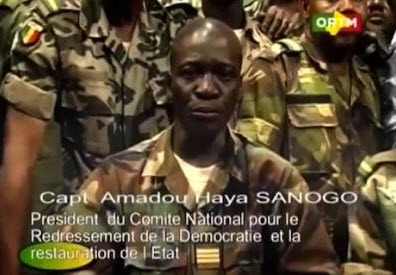
Captain Amadou Sanogo, leader of the CNRDR, announces the coup in a televised address.
Rebellious Malian soldiers declared today they had taken power, removing President Amadou Toumani Touré. The coup is led by junior officers disgruntled by the government’s failure to put down a rebellion by Tuareg separatists in the north of the country.
The coup leaders have formed the National Committee for the Return of Democracy and the Restoration of the State (CNRDR), declaring the constitution suspended.
“The CNRDR … has decided to assume its responsibilities by putting an end to the incompetent regime of Amadou Toumani Touré,” said Lieutenant Amadou Konare, spokesman for the CNRDR, in a televised address.
“We promise to hand power back to a democratically elected president as soon as the country is reunified and its integrity is no longer threatened.”
CNRDR appears to have around two dozen members, all in their twenties and thirties. They are led by Captain Amadou Sanogo, who according to the RFI was an English teacher at the Kati barracks, 13 km from the capital Bamako, where the coup commenced.
From mutiny to coup
The mutiny at the Kati barracks began yesterday following a visit by Defence Minister General Sadio Gassama. It appears that the minister failed to address the troops’ grievances over the government’s handling of the Tuareg rebellion in the north. Soldiers fired shots into the air and stoned the minister’s car. Following this insurrection, the troops captured the state television station, first taking it off air, then playing music videos. President Touré used Twitter to insist this was a mutiny and not a coup. Shortly after his statement, soldiers surrounded the presidential palace. When they broke in and reportedly looted the palace, Touré had already escaped. The presidential twitter account has not been used since yesterday evening. AP now report that Touré is in a Bamako military barracks protected by his elite guards, the Red Berets. France has called for his “physical integrity” to be respected.
The rebellion next spread to Gao, a city in the north of the country which serves as the military base point for operations against the Tuareg separatists. It is reported that senior officers were arrested by their juniors in support of the CNRDR and against the government and military high command’s handling of the northern conflict. On Tuesday, Jeune Afrique reported that recent defeats coupled with claims of corruption had created “a climate of distrust of the Malian army’s top brass” by troops.
It has been reported that Gassama is being held by troops loyal to the CNRDR, along with the former foreign minister and three current ministers. The South African government has called for “senior military officers and political leaders being held hostage” to be released.
Relatively peaceful
Although events have been dramatic they have remained relatively peaceful. 20 people have been admitted to hospital, mostly from injuries sustained from stray bullets fired in the air in support of the coup. There are no reported fatalities.
Flights have been cancelled. The CNRDR has instituted a partially observed curfew and have issued an order to seal the country’s borders. Banks, government buildings, petrol stations, and many shops are closed.
It is likely that the coup leaders will have significant, although not total, support on Bamako streets. Last month saw angry protests, which also started in Kati, against the government’s perceived poor handling of the Tuareg rebellion. Tyres were burned in the street and the presidential palace was surrounded by protesters. The CNRDR appears to be channelling some of that anger. Indeed, in parts of Bamako “people are celebrating with the soldiers”, according to an eye witness source in conversation with the BBC’s Nick Ericsson.
Who are the CNRDR?
Very little is known about the CNRDR. They have released televised statements, both showing around two dozen relatively young men from different sections of the military, and one policeman, in military fatigues. Captain Sanogo appears to be the highest ranking among them.
The revolt, at least for now, does not appear to be orchestrated by senior political figures. Rather, the actions of the coup leaders’ suggest opposition to both civilian and military high command. Not only have ministers and senior military figures been arrested but candidates for next month’s presidential elections, for which Touré expected to have ran, have been targeted. Soumaila Cissé, one of the four frontrunners for those polls, had his house broken into and looted in the early hours of this morning.
Whilst the CNRDR frames itself as wanting to return the country to democracy swiftly, as Touré did after his coup in 1991, their interests appear more military than political. Their grievances predominantly stemmed from the campaign in the north and their only hint at future actions relates to the war. In Konare’s statement, the CNRDR promised to return the country to elected civilian rule “as soon as the country is reunified and its integrity is no longer threatened”. In short: we’ll give back democracy once we’ve won the war.
It is also possible that Sanogo, Konare and the CNRDR are accidental coup leaders. Early reporting by Africable TV, which claimed to have spoken to some of the mutineers, suggested that the rebellious soldiers were demanding more resources for the war, not attempting to remove the government. Indeed, apart from rushing to take state television off air, their actions do not seem planned. They did not have a prepared communique to announce, their television broadcasts suffered from sound problems and appeared amateur. This may simply be a protest, that became a mutiny, and evolved into a coup.
What next?
Whether planned, professional or not, the CNRDR coup could easily hold. If they can keep looting by low ranking soldiers, which is increasing being reported, at bay, they should be able to rely on the support of Bamako’s populace. And if they can provide sufficient weaponry and pay for the battle with the Tuareg rebels, then they should guarantee, at least for now, the support of rank and file troops.
Touré or any possible allies in military high command may prove unable or unwilling to stage a fight back. Although it appears that Touré elite troops, the 33rd Parachute Regiment, remain loyal, many are currently deployed in the north. He only had three months left in office and if his safety and assets can be secured, he may not respond with violence.
It remains to be seen whether senior officers will accept the intrusion of their juniors into public life, although judging from events so far, military high command is not popular in the Malian armed forces. Civilian political leaders and their parties may quietly wait out the predicted six to twelve month delay in the polls.
Although the coup has received complete international opprobrium, with everyone from ECOWAS to the UN condemning the CNRDR, it is highly unlikely that the international community can do much about it. Following the pattern of recent coups in the region, international actors criticise, withdraw funding from and exclude coup-formed governments, but do not intervene further. Evacuating Moses Wetangula, Kenya’s foreign minister, who is stranded in Bamako, is the international community’s only likely success.
The CNRDR came into existence due to the war in the north. This war is set to intensify. In order to maintain control, the coup leaders must have some sort of quick and visible military success, such as recapturing rebel-held towns. The Tuareg rebels are set to take advantage of the confusion caused by the coup and escalate their attacks.
Government workers return to the office next Tuesday, with a food crisis, a refugee crisis and a war in the north to address. If the CNRDR manages to consolidate its grip on power, it will have its work cut out.
History suggests that US support for South Sudanese independence has less to do with democracy and justice than oil reserves.
By Jonathan Jacobs.
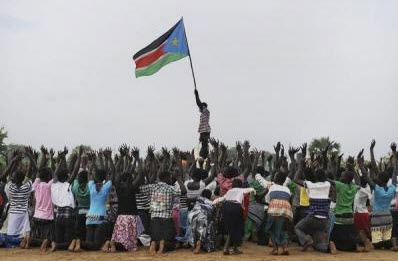
A man waves the South Sudanese flag.
In July 2011, South Sudan declared independence from Sudan, concluding a lengthy, costly and painful battle for self-determination. It was an exciting and long-awaited occasion, and not just for South Sudan. The US, an instrumental actor in the secession, was among the first countries to extend its congratulations to the new state. A stirring press release from President Obama – invoking, not for the first time, Martin Luther King – celebrated “the light of a new dawn” after decades of civil war.
Friendly advice
“I am confident that the bonds of friendship between South Sudan and the United States will only deepen in the years to come”, read the statement. “Together, we can ensure that today marks another step forward in Africa’s long journey toward opportunity, democracy and justice”.
At a Washington development conference in December, Secretary of State Hillary Clinton warned the new president, Salva Kiir Mayardit, of the possible ‘resource curse’ of oil-rich countries and emphasised the need to avoid allowing wealth to be siphoned off by foreign powers and corporations. At the same time, however, the US has moved to accelerate resource exploitation in the region, adroitly sidestepping its own sanctions on Khartoum to declare South Sudanese oil ‘open for business’, and has sent US officers to manage ‘strategic planning’ in the country.
Old buddies
As the contours of this ‘bond of friendship’ become increasingly clear, it is worth looking at the long and complex history of US engagement in Sudan and South Sudan. Analysis of the US-Sudan relationship in mainstream media often takes 2003 and the much-publicised ‘Save Darfur Campaign’ as its starting point, as if the eccentric coalition of evangelical Christians, humanitarian lobby groups and George Clooney represents day one of US involvement in East Africa. The history of US-Sudan relations in fact goes back much further and presents a problematic counter-narrative to Obama’s “new dawn”.
A more appropriate starting point may well be 1978, when the American oil major Chevron discovered oil in Southern Sudan, at that point an autonomous region within Sudan. An uneasy and short-lived peace between North and South was broken when the US-backed and Chevron-friendly dictator, Gaafar Nimiery, moved to redefine regional boundaries to bring the oilfields under Northern control. In 1983, Nimiery revoked the South’s autonomy, dissolved its regional government and instituted Sharia law, resulting in the formation of the militant Sudan People’s Liberation Movement (SPLM), and the return of war.
The US continued to back Khartoum with aid over the next decade, even as the Islamist regime that replaced Nimiery enslaved, murdered and repressed thousands of Southern Sudanese. The SPLA, who mounted attacks on Chevron oil fields, were seen as hostile to US interests. But in 1989, President al-Bashir broke from the US over the Gulf War, prompting the US to transfer allegiance to the Southern rebels. They provided support via the Ugandan president Yoweri Museveni, at that time lionised in the West for his zealous co-operation with IMF structural adjustment. US President Bill Clinton, in 1993, added Sudan to his list of ‘state sponsors of terror’ in, and quietly funnelled arms to Ethiopia, Eritrea and Uganda to help push the rebel cause, hoping to destabilise a Sudan regime pursuing an anti-US agenda.
In the wake of September 11, US interest in Sudan took on a new perspective. Sudan became a front on which two interrelated US objectives could be played out: combating Islamic terrorism, and ensuring energy security beyond an unstable Middle East. The well-publicised 2005 Sudan Caucus and associated ‘Save Darfur Campaign’ created a humanitarian platform for US intervention. A less altruistic lobby had been informing US policy on the region, however, since 2002.
Friends like these…
Taking its lead from Dick Cheney’s report on energy security, the neoconservative think tank African Oil Policy Initiative Group published an influential white paper in 2002, positing African oil as a strategic priority for the US. It recommended that the US reduce oil reliance on an unstable Middle East “by actively participating in the creation of a new zone of security and prosperity in a part of the world receptive to American presence”.
In 2003, the conservative Heritage Foundation set out a more detailed blueprint for what this “active participation” might look like. Their report, ‘US Military Assistance to Africa: A Better Solution’, advises the creation of a US military command to advance security objectives in the region, co-ordinate anti-terror campaigns and, crucially, encourage “prudent management of the continent’s vast natural and mineral resources”. African oil, it argues, is a geostrategic imperative – in that it provides 25% of all US oil – which can only be secured through a systematic military presence. The US therefore “must not be afraid to employ its forces decisively when vital national interests are threatened”.
Sound familiar? In 2007, the Bush administration – which included several Heritage Foundation members – announced the inception of AFRICOM, taking on board most of the Foundation’s recommendations to establish an integrated command in Africa, with forward operating bases across North Africa and Cooperative Security Locations in Gabon, Uganda and Senegal. The placement of these bases gives the US a presence spanning the oil and resource-rich Gulf of Guinea and West Africa, as well as a stronghold in the volatile North.
Obama’s administration has continued and expanded the initiative. Last year’s Libya intervention was an opportunity for AFRICOM to flex its muscles, and the Washington Post recently revealed a secret constellation of new drone bases across the continent. US military officers have been authorised to oversee and secure the independence process in South Sudan.
Stand by me
AFRICOM is just another step in the inexorable harmonisation of US military and economic interests in Africa. It operates as a sort of imperial policeman, protecting strategic interests on the continent and making regions safe for American capitalism, with military force, if necessary. At a conference in 2008, Deputy Commander Robert Moeller admitted that the guiding principle of AFRICOM was “securing the free flow of natural resources from Africa to the global market”. US involvement in South Sudan’s independence must be read within the context of this mission.
The US has not, for all Obama’s lofty talk of noble struggle, been an historically consistent supporter of South Sudanese independence; its shift in allegiance from Khartoum to the SPLM has been guided by expediency and the vagaries of US strategic interests. It is the right time and place for a US-friendly, oil-rich region to secede from a quarrelsome Islamist parent. But the ‘new dawn’ of South Sudanese independence bears the long shadow of US intervention and the dubious promise of further strategic interest.
Underhand dealings ensure the vast majority of DRC society is excluded from the benefits of the country’s mineral wealth.
By Lewis Brooks
A gathering in Kinshasa.
Mining for minerals in the Democratic Republic of Congo (DRC) is big business. The DRC holds vast reserves of cobalt, copper, gold, diamonds and many other minerals with one estimate putting the value of its natural resource wealth at $24 trillion. However, the country performs very poorly on development indices.
Why has the DRC been unable to convert its great mineral assets into wealth for its people? The answer lies somewhere in the relationship between the big businesses and politicians involved in the Congolese mining sector, and how these unions continually fail to be of benefit to the DRC’s citizens.
Underhand dealings exposed
Large amounts of the DRC’s resources are trapped in deposits that require industrial scale mining and processing to turn them into useable forms. Building the facilities for these kinds of operations requires considerable financial investment from the Congolese government, as well as companies in and out of Africa. Large sums of money change hands and relationships are forged, but more often than not the circumstances surrounding these deals are less than transparent and behind closed doors the Congolese people are getting a raw deal.
These concerns have not been helped by the serious allegations of chronic underselling of mining assets which arose in November 2011. British Member of Parliament and chair of the All Party African Great Lakes Group, Eric Joyce, released a string of documents which showed that the acquisition of Congolese mining assets by 9 of at least 45 ‘shell’ companies, recently incorporated in the British Virgin Islands (BVI), had no identifiable experience in the mining sector. These BVI shell companies acquired their shares in previously state-owned mining projects, at below market value, and then sold them on to multinational firms making a huge profit in the process.
Documents show, for example, that a previously state-owned 50% stake in the SMKK mining project was sold to Emerald Star Enterprises for around $15 million. But a fair market valuation of this asset places its value at approximately $75 million. In this one deal, the loss to the state mining company Gecamines, and thus to the Congolese people, was approximately $60 million.
Like many of the state asset sales, this deal was not put to public tender and the benefactors of the deal were not made public by the government. Unfortunately, according to the documents released by Eric Joyce, the SMKK project is just the tip of the iceberg in lost state assets; total losses to date, as a result of such underselling, is estimated to be some $5.5 billion. Joyce even chastises the IMF and states that it has “not been firm enough with the DRC government and has allowed the president and his advisors to run rings around them”.
Smoke and Mirrors
The people of the DRC are not the only ones to have lost out in these shady dealings. Back in 2009, the government seized the Kolwezi Copper Project from Canadian mining company First Quantum Minerals, stating that First Quantum had breached its contract. If the government’s allegations are true, then the seizure is a legitimate response to protect state interests. However, as the episode has developed in the years leading up to now, this perspective has become increasingly questionable. The Kolwezi tailings project was sold on by the DRC government to a group of BVI shell companies headed by Highwind Properties Ltd. According to Eric Joyce’s findings, the 70% share of the Kolwezi project was sold for $60 million. The difference between the price paid by the Highwind group and the fair market value of the assets is astounding; Joyce’s valuation puts their worth at $2.69 billion.
In the most recent development of the scandal, the main stakeholder in the Kolwezi project, Eurasian Natural Resources Corporation (ENRC), agreed to pay $1.25 billion to First Quantum to quell litigations launched by First Quantum against them, Highwind and the DRC government.
Business and Pleasure
The First Quantum/ENRC scandal and the underselling of state mining assets poses a serious question – what motivations are guiding mining policies in the DRC?
The deals are, for the most part, taken without putting the sales to public tender and the finer details are not made public. Furthermore, many of the BVI shell companies buying these mining assets at heavily lowered prices seem to be linked to the same businessman: Dan Gertler.
Both Highwind Properties Ltd and Emerald Star Enterprises are thought to be owned by The Gertler Family Trust. And Dan Gertler, an Israeli diamond merchant, is rumoured to have been involved in supplying President Kabila’s father, Laurent Kabila, with weapons during the Second Congolese war, and is now thought to be friends with President Joseph Kabila. This cross-generational friendship has likely facilitated Gertler’s companies’ windfalls.
Given the scale of the losses to the Congolese state, the nature of secrecy surrounding the selling of assets, and the DRC’s position of 168th (of 182 countries) in Transparency International’s Corruption Perception Index, claims that financial transactions involved personal dealings are far from implausible.
And allegations of personalised deals involving individuals in the government arising from the BVI scandal are not the first warnings of interference in the mining industry by Kinshasa politicians. In 2006, the Global Witness report ‘Digging in Corruption: Fraud, Abuse and Exploitation in Katanga’s Copper and Cobalt Mines’claimed that employees from the state-owned firm, Gecamines, were often pressured into rushing contracts to sell state-assets by politicians close to Kabila. There were also claims that Gecamines’ management structure was “corrupted” with private companies. One of the more worrying claims of the report is that companies are in fact unable to operate in the DRC’s mining industry unless they have a “political umbrella”. The experience of First Quantum suggests that this may well be the case.
Entrenched interests
Although the recent elections provided an opportunity for Kabila’s policies and the direction of the mining industry to be scrutinised, other issues dominated. And with polling over, it is unlikely that a similar chance to demand accountability in the industry will present itself for a while. The general culture of the mining sector is unlikely to change with Kabila in power and individuals friendly to the regime, such as Dan Gertler, are likely to continue to benefit from business.
Asking whether another result in the elections would have meant a wind of change in the mining sector is a largely speculative exercise but it is interesting that in the lead up to the elections, opposition presidential candidate Etienne Tshisekedi, met with First Quantum and other mining companies in Canada. Such a move could easily have worried those companies close to Kabila just as it would have reassured the companies which have lost out in the DRC before. Either way, the DRC’s mining industry does not look as though it is going to be hit by major changes whilst the current elites remain in power and continue to intervene in the industry.
The Joyce report and other developments, which have elucidated dealings tantamount to theft in the mining industry, have not brought comfort to those who hope that the DRC’s abundant mineral resources could be converted into wealth for its people. Companies connected to friends of the president have, in essence, robbed the DRC of a chance to develop. Joyce may call on intervention but with the elections passed, it seems as though the lack of transparency and the self-interested meddling of political elites is set to continue in the DRC’s industrial mining sector.
International election monitors are far from perfect, but African observers are not yet ready to take over.
By Judith Kelley
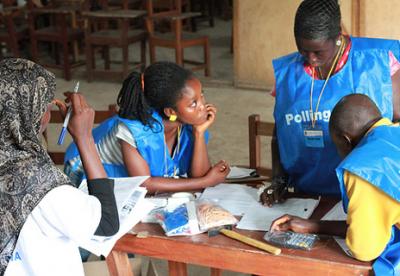
Polling staff in Liberia contemplate how to prepare to count the ballots as an election monitor looks on. Photograph by Brittany Danisch.
In the 1980s, few elections had outside observers, but their presence has grown steadily since then, and today most have at least a few delegations and some have many.
This year alone, the European Union (EU), African Union (AU) and Commonwealth Secretariat were all in Kenya, and the EU is planning to head to Mali and Madagascar later this year. The AU was also in Cameroon in April, and South African Development Community (SADC) observed the constitutional referendum in Zimbabwe.
Election monitors are usually accepted as being a positive sign of a free and fair election, but is all this observer activity actually a good idea?
Watching the watchmen
The presence of observers usually translates into a short press announcement, which is often boiled down to a thumbs-up or thumbs-down. Few people question this outside activity or consider the differences among organisations.
One group that does pay a lot of attention, however, is politicians. After being criticised in earlier years, Zimbabwe’s President Robert Mugabe barred international observers from multiple elections, most recently those this year. A number of other African politicians seem to agree with him. In March, former Nigerian president Olusegun Obasanjo suggested outright that non-African election observers should no longer be present in African elections.
Obasanjo’s claim seems to rest on three ideas: that outside observers sometimes conduct themselves in a less than wholesome manner; that they undermine the sovereignty of the nations they operate in; and that African election observers have matured and developed enough capacity to do the job themselves.
He is partly right on one account, but wholly wrong on the others.
Let’s take the easy one first: that monitors violate the sovereignty of host nations. This is not case. Most African nations have signed international and regional agreements to uphold democracy and hold clean elections. More importantly, international observer organisations only operate in countries based on invitations from the host governments. To enter polling booths and conduct their work, they generally need access, and access usually comes with formal registration. Monitoring missions operate in the open, holding press conferences and issuing reports. Host governments are aware of and have normally consented to their presence.
Now to Obasanjo’s second argument. Here, critics may have a point. There are certainly sometimes questions about the conduct of outside observers.
Elections in Kenya unfortunately often provide a case in point and the latest is no exception. The EU monitors have been dragging their feet, with their final report now overdue. EU observer mission spokesman, Peter Visnovitz, reportedly promised the report would be made public by 4 May, but we are still waiting. Furthermore, in its initial press release (before the counting was complete), the EU was positive despite noting that the biometric voting process disenfranchised more than 3 million voters.
Why is the EU taking so long for its final assessment? The Kenyan Starclaims that an internal report revealed strong reservations about the processing of the results. Meanwhile, the International Crisis Group (ICG) noted numerous problems and criticised the swiftness with which international observer groups pronounced all well in Kenya’s vote.
Earlier commotion around international observers in Kenya includes their muted response to the problems in the 1992 election; the mission was eager to send positive signals to calm fears of upheavals and resume aid. Their conduct in Kenya’s 2007 election also drew criticism from the UN Independent Review Commission; the body reported that monitors had at times based their claims on misunderstandings.
Time for an African solution?
International observers are clearly not perfect. But the final part of Obasanjo’s argument – that cure for the problem is for African monitoring groups to take over from international missions – rests on equally shaky grounds.
It is true that African groups have become more active. The AU, SADC, ECOWAS, and the electoral Institute of South Africa (EISA), among others, all now feature election observer missions. The AU started as far back as 1989, and the other groups have joined in the last 10 years or so.
That, however, is where the argument stalls. By and large, these groups are not ready to take over as the sole option for election observation on the continent. They have limited resources and experience, their sponsors or member-states are often not particularly democratic themselves, and most importantly, because these organisations are even more embroiled in politics on the continent, they are often more biased than non-African observers.
Exhibit number one is the 2011 election in the Democratic Republic of Congo (DRC). The disparity between African and other international observer missions was startling. The Carter Centre called the elections problematic, while the National Democratic Institute, International Foundation for Electoral Systems and EU were also highly critical. Even citizen observers and local media called the process highly flawed. Yet by contrast, the African Union and four other African observer missions including SADC declared the polls “successful” and urged both sides to show restraint. Some suggest the African bodies’ positive reports stemmed from economic and political interests within South Africa.
Exhibit number two is the recent referendum in Zimbabwe. Mugabe had barred Western observer organisations, but the ICG had already issued a report claiming that there were so many problems with the upcoming vote that there was no way it could be legitimate. Still, SADC sent its mission and, although it noted some problems, issued a largely positive report – just as Mugabe had desired, and just as the rest of southern Africa would have hoped.
Exhibit number three is the African Union more generally. It should be the flagship monitoring organisation, but, being hamstrung by many undemocratic members fearful of being the targets of effective election monitoring, it is seldom critical and it rarely releases substantial reports. If it has a page dedicated to transparency on its election monitoring activities on its website, it is well hidden. Despite having released a set of guidelines for observers, it is less than a model for other organisations.
All in all, it is not quite the time to boot out the observer organisations from the wider international community. Despite their problems, they have made important contributions, particular where they’ve worked with local officials to improve voter registries, implement other institutional reforms to bolster election processes, improve the legitimacy of competitive elections, and train domestic observer groups.
Furthermore, whatever legitimate concerns there are around the role of international observers, African organisations have the same problems, only worse. With so many autocratic states and tentative democracies still on the continent, African monitoring organisations still have some way to go before they are ready to hold each other accountable. Keeping the company of other international observers for some time yet is wise. Equally wise is to question any politician who bars observers from any group, and to examine observer reports critically, no matter their source.
A group of Tuareg villagers in northern Mali. Photograph by Emilia Tjernström.
By Andy Morgan.
The Tuareg rebels’ recent attacks represent a fourth roll of the Kel Tamasheq dice.
“Long live Azawad!” “May Allah bless Mali!”
Through December and early January, the tone of the exchanges on various Tuareg chat forums was expectant, frustrated, even desultory at times. Everybody knew something big was about to happen. They had known for some time already. But when exactly? The wait was excruciating. Then, on the morning of Tuesday, January 17, 2012, a new Tuareg rebel group, the National Movement for the Liberation of Azawad (MNLA) attacked the town of Menaka in the north east of Mali.
Messages of support and relief poured in from Mali, Niger, Libya, France, Saudi Arabia and the entire Tuareg diaspora. “The hour has come. We urge all Azawadians to lend their hand in the fight to liberate our Azawad,” wrote a blogger called Targui Rebel Boy. “Aguel’hoc is free and now we’re going to liberate Tessalit. Vive Azawad!” wrote another surfer. “The flag of Azawad is floating everywhere, even over some towns that have not yet been conquered,” and “Long live Azawad, long live Freedom!” went the patriotic outpouring. One online sympathiser, with an almost Churchillian grasp of the magnitude of the moment, urged everyone to make a note of the date, “for 17th January 2012 will live for ever in history.”
There was also internet traffic bearing different perspectives and different emotions of course. As the MNLA quickly moved on from Menaka to attack the towns of Tessalit and Aguel’hoc further north, and casualties began to be reported on both sides, some Tuareg bloggers questioned the wisdom of taking up arms once more against the central powers in Bamako, the capital of Mali. “War is always ugly,” they claimed. “Dialogue is always better.”
The Malian press meanwhile sharpened its fangs and unleashed a torrent of invective against the Tuareg rebels, calling them “armed bandits”, “drug traffickers”, “AQIM collaborators” and “Gaddafi mercenaries.” The news agency, Agence France Press, picked up and relayed these same catchphrases throughout the world, in reports that seemed to rely almost entirely on Malian army sources for their version of what was actually happening 1,200 km away in the far north east of the country. Southern Malian bloggers were even cruder and more violent in their attacks. “A warning to those little wankers from the North…Fun time is over!” read the text accompanying a video of elite Malian army units parading in front of President Amadou Toumani Touré. “Those rebels don’t know about dialogue. They must be killed, killed, killed!” and “May God save Mali from this useless war!” or “Long live the Malian army…may Allah bless Mali!”
The international press led with the angles of the story that are currently of greatest concern to the international community; The fallout from Gaddafi’s overthrow and Islamic terrorism in the shape of Al Qaida in the Islamic Maghreb (AQIM). The general assumption was that this new uprising was a direct result of the Libyan civil war and of the weaponry and demobbed Gaddafi mercenaries that flooded back down into the Sahel to the lands of their origin in the wake of the dictator’s demise. Another generally accepted viewpoint was that the north east of Mali had become a cauldron of crime, Islamic terrorism and insecurity, and that the MNLA were but a symptom of the furies that plague this deeply dysfunctional corner of the southern Sahara.
Neither Gaddafi’s fall nor AQIM are the prime movers
In truth, neither Gaddafi’s fall nor AQIM nor drugs and insecurity are the prime movers behind this latest revolt. They are just fresh opportunities and circumstances in a very old struggle. The first rebellion of the nomadic Tuareg, (or Kel Tamasheq – ‘the Tamasheq speaking people’ – as they prefer to be known) against the central government of Mali broke out in 1963 when a young renegade called Alladi Ag Alla attacked two camel-mounted policemen or goumiers in a remote region north of the town of Kidal. Mali had only just won its independence from France, and the Kel Tamasheq, detached from world events in their far flung desert home, simply could not understand why their cherished independence and age old nomadic culture had been subsumed into a new state ruled by black Africans living hundreds of miles away who had never proved their right nor their fitness to become the Tuareg’s new masters. It was to be six years before Gaddafi grabbed power in Libya in a military coup and 44 years before the Algerian terrorist group, the GSPC, rebranded itself as AQIM and became the north African franchise of a successful global Islamic terror movement.
That first Tuareg uprising in 1963 lasted barely a year before it was crushed with unforgettable brutality by the Malian army under the command of the infamous Captain Diby Sillas Diarra, the ‘butcher’ of Kidal. The northeast of Mali then became a no-go area ruled by martial law. The 1970s and 1980s were decades of extreme drought and suffering in the region that saw many thousands of Kel Tamasheq flee their homelands and take refuge in the neighbouring countries of Algeria, Libya, Niger, Mauritania and Burkina Faso. It is said that the word ‘Tuareg’ means something like ‘abandoned by God’ in Arabic, and in those years of drought and exile, this foreign name seemed cruelly apt.
In June 1990, the second great Tuareg rebellion broke out when Iyad Ag Ghali, the leader of the Popular Movement for the Liberation of Azawad (MPLA), attacked a police post in Menaka with a small group of soldiers recently returned from army camps in Libya. The parallels with the outbreak of these latest hostilities are stark. The 1990 uprising ended in an Algerian brokered peace treaty and the National Pact of 1992. The Tuareg movement then dissolved into a bitter soup of acrimony and acronyms as the MPLA split along ethnic and tribal fault lines into four different factions. The northeast was given a certain measure of self-determination by the government in Bamako. Rebel leaders and soldiers were ‘reinserted’ into the Malian army and administration. But the main clauses of the National Pact were never honoured, and Kel Tamasheq resentment simmered away for the next fourteen years. On May 23, 2006, a new rebel group, the Democratic Alliance of May 23 for Change (ADC) attacked Malian army installations in Kidal and Menaka before retreating to a well stocked base in the Tegharghar hills north of Kidal. Algeria once again stepped in to broker a new peace deal and a new treaty, known as the Algiers Accords, which basically restated many of the demands made in the National Pact. These included greater autonomy for the Kidal region, greater recognition of the Tamasheq language and culture in the national media and in education, the formation of special security units staffed by local Tuareg, economic development in the region, a functional airport for Kidal and a special tax regime for the north to encourage investment. For the next six years north eastern Mali grumbled and groaned under an uneasy peace, while the refusenik Tuareg war lord Ibrahim Ag Bahanga kept the flame of revolt alive by attacking the army and taking hostages.The implementation of the Algiers Accords stalled, then ground to a halt amid bitter accusations and recriminations on both sides. On January 17 of this year, it all kicked off again. For the Kel Tamasheq, this is the fourth roll of the dice in a very long struggle for autonomy.
This uprising is different
The mild cynicism of some veteran observers of Saharan politics as they contemplate yet another uprising in the north of Mali can be forgiven. Previous revolts have adhered to a certain pattern of failure that has repeated itself in varying degrees: a group of well connected and disgruntled Kel Tamasheq community leaders, usually all veterans of the great 1990 uprising, form a new rebel group with a freshly minted acronym. They attack a Malian army base in Menaka, Kidal or Tinzawaten, kill a few soldiers, then retreat to the hills as soon as reinforcements loom on the horizon and wait there while politicians in Bamako, Tripoli or Algiers work out a way of getting everyone around the negotiating table. Then a deal is thrashed out which comprises the enticing lure of financial incentives for the rebel foot soldiers and ‘jobs for the boys’ in the administration or the army for the rebel leaders. A pact or accord is signed, the rebels go back home and the Malian government proceeds to ignore most of its promises. The frustration mounts again over a number years, and, when the requisite level of tension and dissatisfaction is reached, the whole process repeats itself. Meanwhile, the average Tuareg man, woman and child slips deeper into despondency, unemployment, poverty and general despair.
However, there are a number of key reasons why this latest uprising is different from all the others. First and foremost the level of preparation and forethought on the rebel side is unique in Tuareg rebel history. In 1990, Iyad Ag Ghali and his small troupe reportedly went into battle armed with two old hunting carbines and a length of rope. In 1963 the Tuareg arsenal comprised a few old Mauser rifles alongside traditional takouba swords. In 2006 the rebels were better armed, allegedly by Algeria, but the rebel movement wasn’t primed for a long battle. In 2012, the MNLA have assembled one of the most impressive arsenals ever seen in the north of Mali.
Some of the MNLA’s weaponry has come from Libya. Some was already housed in Mali. Some of it has been stolen from weapons stores by Tuareg and Arab officers and soldiers who have deserted the Malian army. What is now becoming clear, however, is that the process of assembling this impressive stockpile of weaponry, and bringing together the soldiers and officers that would eventually use it, was part of a carefully preconceived plan that had been several years in the execution. The main man behind that plan was Ibrahim Ag Bahanga, Mali’s public enemy number one and the recalcitrant hero of hawkish Tuareg everywhere.
Ibrahim Ag Bahanga – the man who had a plan
A veteran of the 1990 rebellion, Ag Bahanga was one of the leaders of the 2006 uprising, alongside Iyad Ag Ghali, Hassan Ag Fagaga and Ahmed Ag Bibi. However, he soon grew disgruntled with the compromises that his fellow rebels in the ADC seemed prepared to make in their negotiations with Mali, and their willingness to hand in their arms before any of the promises made by the Malian government had been delivered. In September 2007, Ag Bahanga formed a new splinter group called the Northern Malian Tuareg Alliance for Change (ATNMC). For the next year and half, until he was finally driven off Malian soil by Malian army-backed militias, Ag Bahanga led a campaign of harassment and terror against the Malian army and security apparatus. It included kidnapping upwards of 80 Malian soldiers and holding them hostage for months, as well as a number of ambushes and daring raids against army posts, especially the one in Tinzawaten, a village right up against Mali’s border with Algeria, which was Ag Bahanga’s ancestral home and fiefdom.
After his defeat in February 2009 and the disbanding of the ATNMC rebel camps, Ag Bahanga was given refuge in Libya. He then dipped off the media radar screen for almost two years, until his return to Mali in January 2011. It now appears that far from idly luxuriating in some grace and favour Libyan villa on Gaddafi’s pay roll, Ag Bahanga used his time in Libya to conceive and execute a master plan designed to give the Tuareg movement a military capacity that would offer it at least some hope of fighting a successful war against Mali. He began to talk to a group of 1990 rebel veterans who had left Mali in disgust after the signing of the 1992 National Pact and become senior officers in the Libyan army, commanding special elite units set up by Gaddafi to fight his desert wars. Most prominent among them was Colonel Mohammed Ag Najm.
When the first cracks began to appear in the foundations of the Gaddafi dictatorship, shortly after protests began in Benghazi in February 2011, Ag Bahanga and a few close allies set about putting their plan into action. They got to work persuading Ag Najm and his fellow Tuareg officers in the Libyan army to abandon their posts and return to Mali with as much weaponry as possible. By early summer, as the Gaddafi regime started to disintegrate, Ag Bahanga’s plan was already well on the road. Tuareg army defectors travelled south west in convoys with large stocks of arms and ammunition, including BM21 and BTR60 ground-to-ground and ground-to-air missiles. The Libyan returnees set up camps in Zakak, Tin Assalak and Takalote, all locations in the remote Tegharghar hills north of Kidal. More arms and more defectors kept arriving and both Mali and the international community started to become increasingly worried.
On the afternoon of August 26, Ibrahim Ag Bahanga was killed in a car crash not far from his base at Tin Assalak. He had many enemies: the Malian army, the Malian people, other Tuareg leaders who resented his uncompromising belligerence, Arab drug traffickers whom he had confronted and robbed on numerous occasions and the secret services of both Algeria and Libya for whom Ag Bahanga was often an intolerable liability. Nonetheless, many who knew Ag Bahanga well and were close to him deny any dark dimension to his death, claiming that he perished when his vehicle somersaulted at speed on one of the desert’s dirt tracks. Others say that his vehicle was shot to pieces by arms smugglers, or drug traffickers or a branch of Al Qaeda, possibly all three of these in one. Whatever happened, his death left a large hole in the bourgeoning revolutionary project, but it wasn’t large enough to stop it.
Gaddafi and the Tuareg were never good friends nor faithful allies
Colonel Ag Najm and his fellow Tuareg officers’ abandonment of the Gaddafi cause and the general pilfering of Libyan arms by Tuareg from north-eastern Mali goes some way to contradicting those who insist that the Tuareg have always been ardent Gaddafi loyalists and blind allies in his games of power and terror. Since the mid 1970s, the relationship between Gaddafi and the Tuareg has been one of mutual opportunism rather than shared ideals or common destiny. When the Tuareg needed a refuge from poverty, drought and joblessness in the 1970s, oil-rich and under-populated Libya was one of the countries they turned to. When the nascent Tuareg rebel movement needed someone to fund their struggle for self-determination in the 1980s, Gaddafi provided army training, a base, some equipment and financial backing. The fact that he then went on to use ‘his’ Tuareg fighters in his wars against Chad and Israel whilst never demonstrating any real desire to make the Tuareg revolt actually happen, reveals the Libyan dictator’s true intentions.
During the 1990s and 2000s, Gaddafi uttered many fine words about being a nomad and a spiritual brother of the Tuareg. He spoke of how the Sahara should be a borderless region, free to all his native sons and daughters. In truth he played double games with aplomb, funding Tuareg dissent with small occasional gifts whilst investing enormous sums of money in the energy and water industries and tourism infrastructure of Mali as a whole. “Gaddafi never helped us,” a veteran of the 1990 rebellion once said to me. “He never did anything for the north. All the money he spent went to the south. We helped him, not the other way around.” When Gaddafi finally starting losing the Libyan civil war, the greatest demonstrations of support for his regime did not occur in the northern parts of Mali, among the Tuareg, as some might have expected. They occurred in the heart of the capital Bamako, where tens of thousands of southern Malians took to the streets to voice their approval of the Libyan dictator and their hatred of the USA, Britain, France and the United Nations.
Gaddafi and the Tuareg were never really good friends or faithful allies. They were never more than partners in a game of coincidental self-interest. True, there were many Tuareg fighting on the Gaddafi side in last year’s Libyan civil war. But they were often obliged or paid to do so. It was a matter of expediency rather than belief. Through times of drought and marginalisation in the 1980s and 1990s, and even right up until last year, anything has often seemed preferable to a life of poverty and starvation back in the Malian desert, including a stint the Libyan army. And it must also be remembered that a sizeable number of Tuareg also fought for the National Transitional Council (NTC) against Gaddafi. So did many Imazighen or Berbers, a fact that is often forgotten by both Western powers and die-hard Arab supremacists in Libya.
In an extraordinarily frank and revealing interview given to the Algerian newspaper El Watan just a few days before his death, Ag Bahanga didn’t mince his words about Gaddafi: “[his fall] is good news for all the Tuareg of the region,” he said. “The aims of the colonel [Gaddafi] have always been opposed to our aspirations. All he ever did was try to use the Tuareg for his own ends and to the detriment of the community. His departure from Libya opens a new path to a better future and allows us to progress in our political demands… Gaddafi was a barrier to every solution of the Tuareg question.”
Brainstorming at the Zakak base – the eternal problem of disunity
With Bahanga gone, the build up of arms and soldiers in the north east of Mali continued. In early October, all the various leaders of a burgeoning new Tuareg rebel movement gathered together in the Zakak base for what can only be described as ten days of soul-searching and brainstorming. “We discussed the past errors of certain leaders of the movement,” says Hama Ag Sid’Ahmed, who was Ibrahim Ag Bahanga’s father-in-law and spokesperson of his ATNMC rebel group. “We talked about where things had gone wrong and tried to agree on a plan and on some common objectives. We created a ruling council, a military état majeur, commanded and coordinated by Mohammed Ag Najm and other senior officers. There are about 40 of them. And we also created a political bureau, which set about analysing and considering all the political aspects including how to raise awareness among the international community, especially the regional powers.”
Past errors boiled down essentially to three areas: weakness of military strategy and material, lack of a strong intellectual and political branch and disunity. Of those three, disunity has always been the biggest problem in previous uprisings. The French conquered the Sahara by fomenting internal divisions within the old Tuareg confederations, turning tribal leaders against each other and vassal clans against the nobility. The government of Mali adopted precisely the same strategy after independence in 1960. The first rebellion of 1963 was weakened by the disagreement between Intallah Ag Attaher, the current aged hereditary leader of the Kel Adagh Tuareg and his brother Zeid Ag Attaher. Intallah favoured cooperation and cohabitation with Mali. Zeid favoured revolt and was eventually captured and imprisoned by Mali in their infamous jail near the remote salt mines of Taodenni.
In 1990, the MPLA splintered after the signing of the Tamanrasset accords. Iyad Ag Ghali, who belongs to the ruling Ifoghas clan of the Kel Adagh, remained as the head of the MPA, having dropped the word ‘Liberation’ from the name of his movement in order to make it more appealing to moderate Tuareg and to the Malians. Many other Ifoghas leaders remained loyal to Iyad and the MPA. The ‘lower class’ Tamasheq clans in the region, especially the Imghad, a subordinate ‘vassal’ clan to the Ifoghas, split from Iyad’s group and formed the Revolutionary Army for the Liberation of Azawad (ARLA), which was led by nobles from the Taghat Mellet and Idnan clans. ARLA also represented some Iklan, or former slaves. The Popular Liberation Front of Azawad (FPLA) were hardliners, opposed to the idea of making peace with Mali before the rebellion’s primary aims were realised. They were made up mainly of Kel Antessar Tuareg from the Timbuktu region and Chamanamas from Menaka. Then there was the Armed Islamic Front of Azawad (FIAA) which was composed mainly of northern Arabs and Moors. It had a more religious character than the other rebel movements and was closely allied to Mauritania and Algeria. All these four movements were represented at one time or another by a kind of umbrella rebel organisation called the Movement of United Fronts of Azawad (MFUA).
Needless to say, all this division and splintering did nothing for the strength of the rebel movement as a whole and it quickly allowed Mali to regain control of events. Things weren’t that much better in 2006, when the ADC eventually split between a faction dominated by Ifoghas Tuareg on the one hand and different factions led by Taghat Mellet, Idnan, Imghad and Chamanamas on the other, all of whom accused the Ifoghas of hogging the limelight in the negotiations and seeking their benefit above all. Ag Bahanga’s schism and his creation of the ATNMC was an outward sign of these internal splits.
These bewildering divisions within the Tuareg community pale in terms of the strife and damage caused when compared to the ethnic wars that have been unleashed by Malian policies of divide and rule. The darkest ethnic conflict in the modern history of northern Mali began in 1992 with the formation of the Patriotic Malian Movement Ganday Koy (MPMGK) or Ganda Koy for short, a Songhoi militia that was backed and funded by the Malian army, and whose main aim seems to have been to foist terror on innocent Tuareg and Arab civilians. The Ganda Koy perpetrated several massacres in the Gao and Timbuktu areas in the mid 1990s, the most famous of which was a massacre of around 60 Tuareg marabout or holy men from the Kel Essouk clan in a camp near Gao in October 1994.
Is the rebel movement more united this time? The answer is yes, at least, so far. The talks in the Zakak camp allowed various concerns and age-old gripes to be aired and a basic consensus to be established around a shared set of goals and an agreed division of roles and responsibilities. The political leader of the MNLA is Alghabass Ag Intalla, the son of Intalla Ag Attaher, the Ifoghas chief who favoured cooperation with Mali back in 1963. But while the Ifoghas still hold on to their historical role as the political leaders of the Tuareg in north eastern Mali, a great deal of effort has been made to spread the message and raise awareness of the MNLA and its aims among the entire population of the north, in all its various ethnic groups and across all the strata of its society, and bring people from all the different clans and factions under one umbrella. Talking to various Tuareg friends in the past few months, the general sense of hope united behind the MNLA was palpable.
Having said that, there are many Tuareg, especially Imghad and Kel Antessar, who are staying loyal to Mali. They include numerous Malian army officers and soldiers, as well local mayors, deputies and senior administrators. A whole group of about 300 Tuareg fighters who returned from the war in Libya late last summer, led by Colonel Waki Ag Ossad, an Imghad Tuareg, made great play of their fealty to the Malian state. They were received with great fanfare by President Amadou Toumani Touré at the Koulouba Palace in Bamako. “We didn’t come back to create a division between communities, and even less to divide the state,” declared Ag Ossad. “The military material that we have brought with us is there to be used by our country, which is Mali. We’ve come to contribute to and maintain peace and security in the north.”
Every rebellion eventually turns into an ethnic war
The MNLA have also made strenuous efforts to present themselves as a revolutionary movement for the liberation of ALL the peoples of Azawad – Tuareg, Songhoi, Arab, Peul – and not just a Tuareg rebel movement. Azawad is the name they give to the independent state they are seeking to create, which they say will comprise the three main provinces of Northern Mali: Gao, Kidal and Timbuktu. If an independent Azawad were to exist, it would relieve Mali of more than 50% of its actual surface area. The MNLA also say they have no designs on parts of the Sahara inhabited by the Tuareg that exist over the border in Niger, Algeria and Libya. They claim that there are large numbers of Arabs and Songhoi already fighting on their side. It’s true that certain important Arab leaders, such as Baba Ould Sidi Elmoctar, the hereditary chief of the influential Arab Kounta tribe, have already thrown in their lot with MNLA. As I write, there are also reports arriving from the desert of northern Arabs in the towns of Leré, Timbuktu and Goundam who are leaving to join MNLA in the field.
Whether or not MNLA can bind together all the different tribal and ethnic groups in Northern Mali until its aims are achieved is still a moot point. Even before open revolt broke out last Tuesday, there were dark mutterings about a resurgence of Ganda Koy vigilante activity. The founder of the movement, Imam Mohammed n’Tissa Maiga, made his intention to rearm and get his militia ready for the growing threat from Tuareg rebels quite plain back in early December. In the past few days, reports from Gao and Timbuktu claim that the Malian army is handing out cash and arms to Songhoi men and urging them to go and attack anyone suspected of sympathy with the MNLA. The spectre of tribal war haunts the north once again. The houses of several prominent Tuaregs in the garrison town of Kati near Timbuktu have been burned by angry mobs wielding machetes and as I write, Tuareg and Arabs in Bamako, easily distinguishable by their lighter skin, are suffering attacks on their person and their property.
The private militias within the Malian army
Even more dangerous to the MNLA than the Ganda Koy are the ethnically based militias that have been fighting the Tuareg alongside the Malian army since 2008. It was during that year that the Malian high command finally realised the futility of sending raw recruits from the southern savannah regions of the country to fight Ibrahim Ag Bahanga and the ATNMC in the arid deserts of the north. The Sahara is completely alien to most southern Malians, and soldiers from the south have never had much luck at defeating hardened Tuareg fighters in their own environment. So the Malian generals changed their strategy and invited two senior army officers from the North to form and train their own militias. The first is a Tuareg called El Hadj Gamou, an Imghad, who seems to harbour a visceral disdain for the Ifoghas Tuareg who are the historical ‘nobility’ in the Adagh des Ifoghas, the name given to the Kidal region by the French in the late 19th century. The Imghad were a subservient or “vassal” clan in the old days, and many Imghad Tuareg favoured the more egalitarian society that Mali imposed in the north east after independence. The Tuareg rebellion has its own element of internal class warfare.
Gamou is the most senior Malian army officer in the region, a feared and ruthless soldier whom the MNLA have accused of numerous human rights abuses in recent days, including torture. His militia is run like a private army which exacts retribution and submission from both professional and private enemies, by force if necessary. The other main militia fighting with the Malian army is led by Major Colonel Abderahmane Ould Meydou, a trim and square-jawed northern Arab who has also, like Gamou managed to carve out a fearsome reputation as an able and daring desert soldier. The MNLA announced his death in action with great glee a few days after the outbreak of recent hostilities, only to emit a collective groan when Ould Meydou subsequently appeared on national TV to denounce rumours of his demise, looking fit, relaxed and debonair.
The ranks of Ould Meydou’s Arab or Berabiche militias were swelled just before the outbreak of hostilities on January 12 thanks to a deal brokered by the Malian government. In return for the recruitment and training of Arab militiamen, a super-rich northern Arab businessman by the name of Mohamed Ould Aiwanatt was released from prison where he was serving a sentence for the role he played in a major drugs-trafficking operation known as “Air Cocaine”. This extraordinary episode involved an entire Boeing 727 stuffed full of cocaine that flew into the Sahara from Venezuela and landed in the remote desert north of a village called Tarkint. The cocaine was then unloaded into a convoy of 4×4 vehicles and disappeared eastwards into the desert, probably en route for Egypt, Turkey, the Balkans and finally Europe. The mayor of Tarkint, Baba ould Cheickh, a close advisor to the Malian President, was implicated alongside Ould Aiwanatt in this and several other major drugs scandals. Aiwanatt’s release from gaol and the hypocritical behaviour of the Malian government in their so-called war on drugs and insecurity infuriated Tuareg opinion, and added more than a strand of straw to the load that eventually broke their back and drove them to war.
Gamou’s and Ould Meydou’s militias were the weapon that eventually allowed Mali to subdue Ag Bahanga’s ATNMC in January 2009. Bamako is no doubt hoping that they can do the same again to the MNLA, even though it presents a challenge of an entirely different order to Ag Bahanga’s underfunded and poorly equipped crew.
All in all, unity and disunity will be among the biggest challenges to the success of the MNLA uprising. This has always been the Tuareg movement’s greatest challenge. No wonder so many desert songs by Tuareg bands like Tinariwen and Tamikrest lament the lack of unity in Tuareg society, and berate Tuareg leaders and politicians for succumbing to tribalism and Malian games of divide and rule. Bamako plays its hand subtly and expertly when the need arises. One of the current MNLA representatives in Nouakchott, Mauritania, and senior political figure from Mali’s north east, Nina Walet Intallou explained how it works: “Mali sends someone, some senior figure in the administration, who is a relative of one of the rebels, to have a discrete word with him and bring him back to the road of peace with promises of money, favours and preferment. Then they send a minister to speak to the leaders of his clan and persuade them to follow the path of peace. That’s not negotiation.”
The Sahara’s Facebook generation
Another novelty in this uprising is the presence of a strong and very active intellectual wing in the Tuareg independence movement. By intellectual, I mean one whose main concern is policy, communication, influence, diplomacy and engagement in geo-political affairs, rather than fighting out in the bush. The lack of such a dimension has been a weakness of Tuareg uprisings since the earliest days. Most rebel leaders have felt more comfortable out in the desert leading their troops than pressing the flesh in the corridors of power. When there have been political men of any worth, their work has often been hampered by a mutual mistrust between them and the military leadership. There’s an apocryphal story about Ibrahim Ag Bahanga that illustrates this lack of intellectual capacity in a damning way. During his time as a renegade in the remote Adagh des Ifoghas a few years ago, Ag Bahanga once received an envoy with an important message from the government in Bamako. The envoy handed over the sealed letter and Ag Bahanga proceeded to open it and, holding the missive upside down, pretended to read it thoughtfully. He then told the messenger that he would “think the proposal over” and sent him away.
Ag Bahanga was a man of many talents, but written correspondence and the fine arts of communication weren’t among them. He was in his element at the head of a rebel group out in remoteness of the desert bush, not in the fine gilded halls of ministries in Bamako, Tripoli, Algiers or Paris. It was often left to his father in law and spokesperson, Hama Ag Sid’Ahmed to be Ag Bahanga’s ‘voice’ on the international stage. Ag Sid’Ahmed is now the chief spokesperson of MNLA, and one of the more worldly and politically experienced men at the head of the movement. But even he recognises the need for an active and engaged ‘intellectual’ dimension to the MNLA project, and his co-revolutionaries agreed that this was a great failing in the past.
Cue the National Movement for Azawad or MNA, an organisation that was created by a group of young Tuareg students and graduates in late 2010. These well educated, internet savvy and youthful revolutionaries gathered together in Timbuktu at the end of October of that year and declared their intention to find a political, legal and peaceful route to Azawadi independence. Their discourse was non-tribal, non-ethnic, inclusive, literate and fluent. In their first declaration, issued as a press release, on November 1 they wrote: “Today, Azawad has become a zone of conflict fought over by countries and extremist groups who care only for their own interests. As for the Azawadis themselves, they are simply caught between the anvil and the hammer of so called terrorist groups. Azawad is now prone to all manner of regional and international interventions…in which the people of Azawad are given no role at all, except that of a useless spectator, forced to look on while the image of their homeland is ruined and its national riches plundered by governments and multi-national companies….Aware of the pain that our people have suffered for decades, as sons of the nation and defenders of a cultural identity threatened with extinction, who are merely perpetuating the struggle of the ancestors, whilst adhering to universal human values…we announce today the birth of a National Movement of Azawad (MNA).”
At the end of this inaugural meeting, two of the MNA’s leaders, Moussa Ag Acharatoumane and Boubacar Ag Fadil, were imprisoned for treasonous activities damaging to the territorial integrity of the state. They soon became Facebook heroes, a cause célèbre among the youth of the Tuareg diaspora. After numerous demonstrations and petitions they were freed. Acharatoumane and his fellow revolutionaries had already set about disseminating the message of revolution among the younger demographic of the northern deserts. Their work resulted in several small demonstrations in Kidal, Menaka and Timbuktu, that occurred around the same time as the launch of the MNA. These events marked the emergence of the Sahara’s own Facebook generation, one acutely conscious of its role models in Tunisia, Egypt, Libya, Yemen, Bahrain and elsewhere, and energised by the idea of flexing its own people power. The MNA soon set up a functioning and well maintained website as well as a very active Facebook forum and an online newspaper called Toumast Press, which features well written and well argued, although admittedly partial, articles about the current situation in the desert. Apart from anything else, this new generation is less encumbered by the divisions, the compromises and the defeats of the past. They are free of the cynicism that is born out of defeat. Their horizon is straight, clear and blue and nothing less than victory will satisfy them.
As soon as hostilities commenced on January 17, a continuous flow of communiqués and updates by Ag Acharatoumane, Ag Sid’Ahmed and other MNLA spokespersons started to be posted up on the web and circulated via online social networks. This energetic PR was in stark contrast to the almost complete lack of communication by the ADC in the first few days of the uprisings in May 2006, a void which allowed all kind of crazy assumptions and claims to be made by the Malian army and circulated without hindrance by the international press. The propaganda war is a great deal more involved this time round, and the two sides are more evenly matched.
The MNLA – a better balanced and multi-faceted movement
With the inclusion of the ‘internet generation’ rebels in the MNA, the MNLA has achieved a better balance than previous rebel movements. “It’s important to define who is who in this movement so that there’s no blurring of boundaries with other agendas and issues,” says MNLA spokesperson Hama Ag Sid’Ahmed. “Mohammed Ag Najm has come back from Libya with officers and men. There are also those who have deserted from the Malian army, more than six senior army officers. There were fighters who were with Ibrahim Ag Bahanga in the ATNMC. And then there was these new elite from the younger Tuareg generation, who were very present on the ground and who had done some very good work raising awareness among the population of the Azawad.”
Alongside this new composition of the rank and file, there have been changes in the rebel movement’s leadership, and with that, a change in its all important relationships and ties to Algeria and Libya. Iyad Ag Ghali is no longer the boss, and the crust of compromise that has adhered to his name ever since the national pact of 1992, his less than crystal ties with the Malian government and Algerian governments and military intelligence services, with Libya and others, has been chipped away and discarded by the new movement. This is a crucial development. All previous uprisings were successfully manipulated, or “defused”, depending on your point of view, by Algeria and Libya. The fact that both countries have also been accused of being the instigators and supporters of these same uprisings demonstrates the mind boggling complexity of southern Saharan politics.
A different relationship with Libya and Algeria
The prospect of Tuareg autonomy in northern Mali has never been attractive to either Libya or Algeria. In fact, all the nations in the region have always viewed the idea of independent Azawad with absolute horror. Both Algiers and Tripoli have always known that at the first sign of a truly successful Tuareg uprising in Mali, their own Tuareg populations in the south would inevitably begin to harbour up some very uncomfortable notions of their own potential autonomy. But the threat doesn’t end there. Ever since the outbreak of hostilities, the various disgruntled Berber populations of Algeria and Libya have been voicing their unbridled support for the MNLA and their delight at the prospect of fellow Berbers (the Kel Tamasheq are a branch of the wider Imazighen family) giving a culturally oppressive regime a bloody nose. The most in depth interview accorded to any MNLA representative yet has been the one that spokesperson Mossa Ag Attaher gave to the Berber website www.tamazgha.fr. The messages of support from Berber secessionist organisations such as the Movement for an Autonomous Kabylia (MAK) or World Amazigh Congress (CMA) have been effusive.
Gaddafi is no longer around to muddy the waters on behalf of Libya, and the NTC have too many problems of their own to take a very active part in what’s happening in northern Mali. That leaves Algeria. When the MNLA tried to capture the northern town of Tessalit on January 20, they learned that there were a number of Algerian army trainers and special ops personnel in the nearby Malian army camp at Amachache. The MNLA commander gave them 24 hours to leave, but rather than obeying, the Algerians proceeded to send more soldiers to Amachache and resupply the base. Far from instigating this rebellion, or supporting it, or even manoeuvring into their usual position as peace brokers, it seems that Algeria has thrown it’s lot in with the Malian government against the rebels. The truth is that Algeria has been excluded from the action this time round and so it has decided to play hard and show its true colours by supporting Mali in an attempt to make sure that an independent Azawad never sees the light of day.
“Since 1963, the attitude of Algeria has always been that if Mali gives autonomy to the Tuareg of Azawad, they’ll also have problems with their Tuareg,” agrees Nina Walet Intallou. “In reality, they’ve always wanted to take over this region. They see it as part of Algeria. When you think that there was the Algerian consulate in Gao that would give Algerian nationality to anyone who asked for it, from Kidal or anywhere, that’s proof. But it isn’t Algeria or Libya that will intervene this time round. From now on, we will only address our problems to the United Nations and the European Community.”
The fact that Algeria has been excluded from the party is possibly linked to the recent fall from grace of Iyad Ag Ghali. “When we created the MNLA there were many of us who said that Ibrahim Ag Bahanga had been too manipulated by Iyad,” a senior MNLA political figure explained to me. “The condition that people gave before putting their confidence in Ag Bahanga and his people was that he detach himself from Iyad, because of all the mistakes that Iyad made in the past. Iyad was totally in favour of the Tamanrasset accords [of 1991] but once they were signed, he never spoke about them again. He never opened his mouth to denounce what happened afterwards, even though he was supposed to be the leader of the entire Tuareg movement. In creating the MNLA, we wanted new people in charge, who had serious objectives, and not people who would drag us between Mali and Algeria.”
The sidelining of Iyad Ag Ghali and his Islamist vision
The story goes that Iyad Ag Ghali came to the meetings at the Zakak base in October, and put himself forward as a candidate for the post of Secretary General of the MNLA. However, his candidacy was rejected, due to his past silences and obscure dealings with the governments of Mali and Algeria. Instead, the post was filled by Bilal Ag Acherif, a cousin of Ibrahim Ag Bahanga. There was an overwhelming sense that this time round the movement needed fresh thinking at the top, independent of Algerian, Malian or Libyan meddling and that all the half measures of the past, the broken treaties brokered by one or other of the regional powers, the compromises and the stalling had to stop. This time, it was full independence or nothing.
After being turned down the MNLA leadership at Zakak, Iyad Ag Ghali also presented himself to an important meeting of the leaders of the Ifoghas clan, to which he belongs, in Abeibara north of Kidal. There he proposed that he become the political head of the clan and be allowed to pursue an Islamist vision of an independent Azawad. Once again his candidature was rejected, and instead Alghabass Ag Intallah as chosen as the new political leader of the Ifoghas, in place of his ageing and infirm father.
At the end of the great rebellion of the 1990s, Ag Ghali became increasingly religious and ‘spiritual’ in his outlook, growing a huge and venerable beard in the process. He was attracted to the teachings of Pakistani preachers belonging to the huge worldwide Muslim proselytising organisation, the Tablighi Jama’at, who were present in Kidal in the late 1990s and early 2000s. Tablighi Jama’at is over years eighty old, has over 20 million members worldwide, and does not preach violent jihadism. In fact, if anything, its approach is largely pacifist and spiritual. Ag Ghali and other Tuareg seemed moved by the urgent call of these foreign preachers for a return to the core values of Islam, and Ag Ghali even travelled to Tablighi Jama’at’s headquarters in Raiwind, Pakistan, to learn more. He later spent time studying at the mosque in St Denis, in the northern suburbs of Paris. Many, if not most of Iyad Ag Ghali’s fellow Malian Tuaregs however either steered clear of Tablighi Jama’at or took a vague or merely temporary interest in them before finally deciding that they preferred to stick with the more tolerant and ‘Berber’ form of Islam which Tuareg have long been known to espouse. The Pakistani preachers ended up getting into trouble with the authorities in Kidal and Gao, becoming mixed up with local politics and electioneering, and finally being politely but firmly asked to leave the region.
Ag Ghali however continued on his religiously inspired path, whilst still holding down the jobs of rebel in chief and general high level fixer. He played a central role in the negotiations for the release of 32 Swiss, German and Dutch hostages from the grip of a GSPC katiba led by the shady Algerian emir Aderrazak ‘Le Para’ in 2003. This first close contact with the terrorist group that would eventually become Al Qaeda in the Islamic Maghreb, has left a penumbra of doubt and suspicion around Iyad’s name that has spawned all kinds of theories, of varying degrees of implausibility, about enduring connections and even collaboration between Iyad and Islamic terrorists or Iyad and the Algerian secret services, the DRS. None of these theories has ever been proven beyond doubt. However, when Iyad was sent to be a consular advisor at the Malian consul in Jeddah, Saudi Arabia, in 2007, following the 2006 uprising which he essentially lead, he reportedly got himself into deep water by associating with proscribed extremist figures or groups. He was eventually expelled from the country and flown to Paris, before returning to Kidal.
Iyad’s talk of the benefits of sharia law for the Tuareg nation went down badly at the Abeibara meeting. One female delegate told him that he had a long road to travel before his fundamentalist dreams of a sharia state became true, as he would first have to climb over the bodies of all the dead women of Azawad, not to mention those of the dead men. His ideas were simply unacceptable. Iyad then declared that if that was the decision of the assembled Ifoghas leaders, then he would go off and form his own movement. This he promptly did, calling his new organisation Ansar Eddine. He declared its main aim would be to install sharia law in the Adagh and rehabilitate the primacy of the ulema, the council of religious elders.
Iyad Ag Ghali, Ansar Eddine and Mali-AQIM collusion theory
Iyad’s creation of Ansar Eddine and his reported ties with a certain Abou Abdelkarim aka Le Targui, one of the minor AQIM leaders operating in the southern desert, have opened the flood gates to national and international speculation about the possible links between the Tuareg rebel movement and Islamic terrorists, a link that the Malian government is all to keen to stoke and publicise in order to discredit the movement. As his name indicates, Abdelkarim le Targui is supposedly a Tuareg, a native of the Tinzawaten region and the erstwhile preacher at the mosque in In Khalil, a remote and fairly lawless border town in the far north east of Mali. He is reportedly a subordinate of the thuggish emir Abou Zeid, and leader of his own small katiba called Al Ansar which was responsible for kidnapping the septuagenarian French humanitarian worker Michel Germaneau in 2010. According to an announcement by Abdelmalik Droukdel, until recently the supreme leader of AQIM, which was posted up on the AQIM website, Abdelkarim Le Targui was also responsible for murdering Germaneau in cold blood as well as negotiation major drug deals on behalf of AQIM with the representatives of a Colombian drugs cartel in Guinea-Bissau. Not the kind of person you should be associating with if you want to present yourself as a legitimate political organisation.
Iyad’s association with Abdelkarim Le Targui is vague and conjectural. Some Tuareg even argue that far from being a true targui, Abdelkarim is an Algerian Arab, like all the other AQIM leaders in the southern desert. Nonetheless this link, together with the perceived religious extremism of Iyad and his Ansar Eddine movement, has spawned a smear campaign in Bamako which aims to convince the world that the MNLA are in cahoots with AQIM. The AFP reporter in Bamako even claimed that Abou Zeid took part in a recent MNLA attack on the army in the village of Aguel’hoc north of Kidal. Nothing is more poisonous to the international image of the Tuareg cause than this taint of fundamentalism and AQIM, not even the Gaddafi links.
There are several reasons why that taint is wholly unjustified. The first is that since the inception of the MNA and MNLA movements, one of their loudest, most cherished and oft repeated aims is to rid their homeland of AQIM, an organisation which they consider to be one of Mali’s most effective weapons in its fight against their cause. “AQIM was parachuted in and installed in our territory by the Malian government,” declares Hama Ag Sid’Ahmed, with total conviction. “It was the initiative of certain drugs barons, who are advisors to the President, in the shadows of the Koulouba Palace [The Presidential palace in Bamako]. They brought them into the Timbuktu region and then to Kidal. In return for the release of the 32 hostages in 2003, a pact of non-aggression was signed between Bamako and Al Qaeda, who then progressively occupied this territory. Those contacts became permanent and it’s clear that since then all the operations led by the terrorist groups have originated in Mali, and the terrorist have always fallen back to Mali. It’s their safe haven. Everyone knows that the terrorists are in communication with military leaders, and that politicians from Bamako meet the terrorist emirs quite regularly.”
Far fetched? Maybe. Like Professor Jeremy Keenan’s controversial theory that AQIM are a creation of the Algerian DRS, the Mali-AQIM collusion theory remains conjectural. But the circumstantial evidence that links a cabal of Malian army and secret service operatives, usually Arabs from the north of the country close to the upper echelons of Mali’s political and military hierarchy, to the huge drug smuggling operations that have blighted the stability of the northern deserts in recent years and to AQIM is very strong. It’s hardly a secret anymore that a consensus exists among US, French and Algerian diplomats in the region that Mali has been long on words but short on action in its dealings with AQIM since 2006. The frustration with Mali’s lack of firm resolve and decisive action in this regard, despite the millions of dollars in aid that it has received from the US and France specifically for the purpose of fighting terrorists on its soil, has been growing exponentially in the embassies and foreign ministries of the world powers. Apart from one clash with AQIM in the desert north of Timbuktu back in 2006, there have hardly been any confirmed reports of the Malian army doing any damage to AQIM at all. In fact, the most determined opposition that AQIM has encountered during its five year campaign of terror in Mali has been at the hands of the ADC, the Tuareg rebel movement launched in 2006, who skirmished with the terrorists several times between 2006 and 2009, with lives lost on both sides. And now that the entire might of the Malian army has been thrown against the Tuareg uprising with such devastating force, including fighter jets, tanks, armoured vehicles, missiles of every stamp and thousands of troops, it’s little wonder that Tuaregs, diplomats, analysts and commentators are feeling a tad cynical about Mali’s repeated assertions in recent years that they’ve never had the military wherewithal to deal with the AQIM threat.
A senior Malian politician once had the temerity to declare in a private meeting at the US Embassy in Bamako that the presence of AQIM in the north east of the country was a good thing, as long as it meant that the Tuareg rebel movement wasted its resources and time trying to combat it. At another meeting, the new Algerian ambassador informed his US counterpart that he suspected collusion between Mali and the terrorists. He cited the then recent case of a joint Algerian-Malian operation to attack an AQIM base that had failed because the AQIM katiba in question had been tipped off in advance. All these frankly startling revelations are contained in the US Embassy cables leaked by Bradley Manning and Wikileaks. In fact, there is no better way to understand what really went on in the northern deserts of Mali between 2006 and early 2010 than to read those US Embassy cables. The level of intelligence, analysis and research contained in them is often of the highest order. And yes, they do reveal that the US Embassy has also suspected Mali of at best tolerating and at worst colluding with AQIM at one time or another.
If the implantation of AQIM on Tuareg soil was part of a deliberate Malian strategy, then it has been extraordinarily effective. The main campaign of AQIM kidnapping and extortion began in March 2008 (interestingly there had been a five year hiatus since the 2003 hostage incident), just when relations between Mali, the ADC and Ag Bahanga were reaching their nadir. Since that time AQIM has knocked the Tuareg rebellion squarely off the front page, both national and internationally. Until January 17 of this year that is. The presence of AQIM in Mali put the country in the front line of the USA’s global war on terror, giving it kudos and a receptive ear in Washington whilst justifying the huge amounts of money, training and equipment that America lavished on Mali in the context of its Trans-Saharan Counterterrorism Programme (TSCTP) and Pan Sahel Initiative (PSI). It has also emptied the north of foreign journalists, foreign observers, foreign NGO workers, foreign tourists and foreigners in general, whose presence could have been inconvenient for certain shady army or secret service (DGSE) operations, especially those linked with the drug trade. Most of all, AQIM have simply throttled the region and deprived its Tuareg population of any hope of building a viable future and developing a strong economy. In short, AQIM has crippled Tuareg society in Mali’s north east. No wonder MNLA have vowed to rid their land of Al Qaeda.
And yet Iyad Ag Ghali’s Ansar Eddine movement continues to sow the seeds of doubt and Mali’s propaganda machine continues to milk any possible connection between the MNLA, Iyad and AQIM for all its worth. Apparently Iyad tried to sell his plan for an Islamic inspired movement to the Ifoghas meeting in Abeibara by promising that his political approach would be no different to that of the moderate Islamic parties that have come to power following the Arab uprisings in Tunisia and Egypt. There also happens to be another Islamic organisation in Mali with the name Ansar Dine. It has a vast following amongst southern Malians, who flock to football stadiums in their thousands to hear the preachings of the movement’s leader, Cherif Ousmane Madani Haidara. Ansar Dine preaches tolerance, democracy and social morality inspired by faith in the teachings of The Prophet. It is also an ardent critic of government corruption and incompetence. Perhaps Iyad sees his movement as a Tamasheq off shoot of the bigger Ansar Dine. Who knows? “What’s very important is that all the religious leaders of the Adagh des Iforas have categorically rejected this foreign Salafist culture that has been planted in their midst,” Hama Ag Sid’Ahmed declares with emphasis. “I know that Iyad is an important person in the region and I know that he’s involved in religious matters. But I cannot believe that he would completely abandon the tolerance that is part of our Tuareg culture. Not for one second. Maybe Iyad and others realise that AQIM has a hold on some of our young people, and they’re trying to present a different message about Islam that might possibly win back all those that the Salafists have co-opted into their ranks.”
Why rebel?
Two questions remain to be answered. Why rebel now? And why rebel at all? The latter question often perplexes curious outsiders. What, they wonder, do the Tuareg people have against Mali, a country which, on the face of it, seems relatively friendly, peaceful and tolerant. It is after all one of the better functioning and more stable democracies in Africa. It is renowned for its culture, its ancient sites of religious devotion and learning, and for its musicians, who are better known outside Africa than any of its political leaders. Mali has many fans throughout the world, justifiably so. What makes the Tuareg so determined to tear this country apart and wreak havoc on its population?
“Our inclusion in the country was a mistake,” is Nina Walet Intallou’s blunt answer to that question. “In the beginning, just before the end of colonisation, a letter was written by some desert leaders to General De Gaulle pleading with him to let the Tuareg and other ethnicities create their own state in the middle of the Sahara. Only four tribal chiefs signed it, but there was never really any proper explanation given by the French to the Tuareg, telling them “Listen, we’re going to leave you and your homeland will just be sliced up into four or five parts and given to different countries [Mali, Niger, Algeria, Libya, Burkina Faso]. You will be given to Mali.” We had never been colonised by Mali before. It was something quite brutal and at the time there weren’t any intellectuals who could measure the consequences of it all. The leaders didn’t realise that the south of Mali would come and occupy their territory. They thought that they would remain masters of their own country in an independent Africa. When they saw the people of the south who came and said, “Now, you’re under our authority,” they were completely perplexed.”
That’s the original sin, that duplicitous betrayal of the Tuareg and their “colonisation” by Mali at independence. It has been entrenched and deepened by war, oppression, drought, corruption, exile, marginalisation and a painful chain of cause and effect, tit for tat, hurt and vengeance, ever since. But in the end, it all boils down to that original “mistake”. All attempts to convince the Tuareg as a whole that they are and should remain proud citizens of Mali have, by and large, failed. Not for all, but for most. Apart from religion, the cultural and social bonds that tie the Tuareg to Malians from the south are just too weak to make the idea of belonging to the nation called Mali acceptable in the northern deserts. And it’s the same vice versa. To most southern Malians, the Sahara is another place and a generally fearful one at that. For a southern soldier from Sikasso or Kati, being sent up north to patrol the open desert is akin to a Muscovite being sent to Siberia in the 19th century. It’s another world.
Nonetheless there are Tuaregs, a large number in fact, and even more Arabs and Songhoi, who do see their future within the current borders of the Malian state. Those people have in a sense made their peace with the idea that Mali is one nation that can include all its diverse peoples. They argue that development is more important than nationalism or ethnic separatism. Mali has always emphasized the idea of inclusivity, of a state that would treat all its citizens, black, white, Muslim, animist, northern, southern, with equanimity. It sees the Tuareg propensity to rebel as an act of downright ingratitude, emphasising the special treatment the north east has received in terms of investment and political freedom, compared to other parts of the country, ever since 1992. The north may be poor, but Mali as a whole is poor, so what are the Tuareg complaining about?
Most Malians in the south resent the idea of their country being split in two. They point out that the ‘white’ Tuareg and Arabs aren’t the only ethnicities in the north. There are also Songhoi, Peul, Bozo, who are black like them. Why should they be forced to secede and become part of this Azawad? It is a pertinent question that the intellectual wing of the MNLA are trying hard to answer with their claims that Azawad will be for ALL the people of the north, not only the Tuareg. And of course, most Malians realise that under those northern deserts there are immense deposits of oil, uranium, gold and phosphates that could one day make their nation rich. They are loath to give up on that enticing prospect.
Nonetheless, the Tuareg who are fighting the Malian army have no doubt in their minds that theirs is a just cause, that their land and freedom and dignity were taken from them by subterfuge in 1960 and that they have been duped ever since into accepting their unhappy state. No longer. The father of the military leader of MNLA, Mohammed Ag Najm, was killed by the Malian army during the first ever uprising in 1963. Make no mistake, this is not a storm in a tea cup involving a few disgruntled returnees from the Libyan war, or a few irate drug dealers and traffickers settling scores, it’s battle driven by dreams of a better future, although tainted in a small way, no doubt, as is the way of the world, by other motivations like vengeance and gain. Whether those dreams are justified or not is debatable, but they are real.
Why rebel now?
In December, before the outbreak of hostilities, a revealing essay entitled “Azawad, it’s now or never” appeared on the Toumast Press website. Written by Ahmeyede Ag Ilkamassene, it outlined the apparently favourable geo-political climate for the Azawad cause that existed at the end of 2011, citing the independence of South Sudan and Eritrea as examples of mistakes made at the time of decolonisation that had been rectified and which therefore proved that the idea of an independent Azawad wasn’t just pie in the sky. It pointed out that the structures that had dominated global politics since the second world war were changing, that new powers like China, Russia, Brazil and India were coming to the fore and that these powers were more open to the idea of the post-colonial settlement in African being dismantled and rebuilt.
Ag Ilkamassene also proudly stated that, this time, the Tuareg revolutionaries were prepared for battle. They would not be hampered by the syndrome of the rusty canon that refused to fire on French forces during the capture of Agadez in 1916, thereby ensuring the defeat of an uprising led by the first great Tuareg independence fighter, Kaocene Ag Gedda. This time the dreams of Kaocene, Zeid Ag Attaher and Mohammed Ali Ag Attaher could come true. Another inspiration was the Arab spring, which had been closely followed throughout the southern Sahara. “For the first time in the history of humanity,” writes Ag Ilkamessene, “revolutions are occurring simultaneously at all four points of the compass.”
The essay defined a zeitgeist that, claimed Ag Ilkamessene, was propitious for the decisive move. Then there were the local realities on the ground in Northern Mali, the opportunities not to be missed, such as the arrival of the Libyan contingent with their arms. The MNLA also cite the fact that the Malian government had been progressively rebuilding and reequipping its military infrastructure in the North east since early autumn 2011, using money that was supposed to be spent on economic and social development in the region, or fighting Al Qaida. Add to that the recruiting of Arabs for Ould Meydou’s militias, and the rumours that the Ganda Koy were getting ready to rearm, and that feeling of ‘It’s now or never’ became overwhelming.
Hama Ag Sid’Ahmed puts the outbreak of war down to the repeated refusal of the Malian government to negotiate seriously with the MNLA, or even to give it any official recognition. “We called on the government of Bamako to take the difficult situation in the region seriously on several occasions,” he says. “Bamako’s response was simply that the situation didn’t exist. They thought any problems were under control or if not, they could be solved by trickery. We told them to be careful, because the problem exists and it’s serious. There’s permanent insecurity in the region, and terrorism too. We can’t live with that.”
In late November, Bamako sent a delegation of National Assembly deputies to the desert north of Kidal to go and meet with the Tuareg soldiers who had returned from Libya. The Malian newspaper L’Essor recently published a fascinating eye-witness account of these meetings out in the open bush, which ultimately ended in failure. The delegation of eminent senior northerners found it hard to listen to the demands and discourse of the relatively young secretary general of the MNLA, Bilal Ag Cherif. Age is very highly respected and deferred to in Tuareg society. But apparently not this time. “You speak in the name of Azawad when you don’t even know what it is,” retorted an angry deputy after Ag Cherif had spoken. “We deputies have been elected and we are natives of this region. You’re demanding something in the name of the inhabitants of the north without having any mandate from them. Where is your legitimacy?”
Then, on January 7, Bamako sent Mohammed Ag Erlaf, a former Tuareg rebel and a senior bureaucrat in the Malian administration, who for the past few years has been managing a huge project called The Special Programme for Peace, Security and the Development of Northern Mali (PSPSDN), to talk to the MNLA leadership. He outlined a set of promises that sounded uncannily like those Mali had already made in 1992 and 2006. They included a special offer aimed directly at Iyad Ag Ghali to create a new post of cadi, or Muslim judge, for each administrative region of the North, and of an imam for every major mosque. The Tuareg rebel leadership were tired of such approaches and they resented way in which Ag Erlaf tried to separate one leader from another by promising each special favours. It smacked, once again, of that old divide and rule policy.
So that was that. The time for talking had come to an end. The dice were cast. Ag Najm and his troops set off for Menaka.
Postscript – The dirty war
Today, as I write, the rebellion has entered its second week. The MNLA have attacked the towns of Lere and Niafunké in the west of Mali, reaching further beyond MNLA’s north-eastern heartlands than any other rebel movement since 1990. Instead of attacking a town and then immediately disappearing off to the hills, the MNLA are trying to hold on to their gains, and extend their reach, thereby over-stretching the under-paid and often demoralised Malian troops to their limit. News from the desert is scant, and objective verifiable news is almost non-existent. However, as predicted, it does seem that the MNLA are giving the Malian army the kind of challenge that the north of Mali hasn’t seen in twenty years, if ever. Nevertheless, it’s hard to conceive how this mitigated military success will ever translate into the birth of an independent Azawad. The pressures against that ever happening, both from within Mali and, more importantly, from all the nation states of West Africa and Maghreb, and the global powers, is just too strong. But MNLA believe it can be done. Only time will tell.
What’s certain, and what was always predictable, is that this conflict is also fast degenerating into a dirty ethnic war, pitting Bamana, Manding, Songhai and Peul against Tuareg and Arab. There are reports of burning and looting and machete attacks on northerners living in the south. Unconfirmed, as always, but the direction of events seems clear. Whatever happens, the loser will inevitably be that unity, that fraternal bond between peoples and cultures Malians have cherished for so long.
Wikileaks cables concerning Somalia’s civil war give an insight into the political players involved in this conflict.
By Chiara Francavilla
Wikileaks cables on Somalia document important and previously undisclosed sentiments expressed by members of the international community on a range of issues. Unearthing uninhibited discussions about the 2006 Ethiopian intervention, the reputation of the Transitional Federal Government (TFG), the sanctions on Eritrea, and the World Food Programme’s activity in the country, these once confidential communications reveal the more private beliefs and interesting dynamics behind the statements and positions taken publicly.
The 2006 Ethiopian intervention in Somalia
In December 2006, the Ethiopian army entered Somalia to fight alongside the TFG against the Union of the Islamic Courts (UIC). At this point, the UIC had control over large sections of Southern Somalia.
In public, USA’s Bush administration consistently denied that it encouraged Ethiopia to cross the Somali border. In an interview with Al Jazeera, Jendayi Frazer, the US Assistant Secretary of State for African Affairs, said: “I have said many times that we counselled Ethiopia not to go into Somalia, but Ethiopia went in for its own security interest, which we understand. They also went in on the invitation of the Transitional Federal Government.”
However, the wikileaks cable dated June 2006 appears to contradict these statements. In the cable, a member of the United Nations Mission for Ethiopia and Eritrea reports a meeting between Frazer and another US official. Frazer is reported to have said that a victory for the UIC would represent the “worst scenario” for the US. He explains:
“This scenario would pull in Ethiopia which, through a rapid in and out intervention, would strike before UIC could get to Baidoa (headquarters of the TFG). While the US fears this type of reaction, it would rally with Ethiopia if the ‘jihadist’ took over.”
This comment suggests that although in the past the US and Ethiopia disagreed on how the Somalia conflict should be resolved, at this particular moment, the unprecedented military successes of the UIC had led the US into a change of policy whereby “any Ethiopian action in Somalia would have Washington’s blessing”. Concerned about potential threats to their own security under a jihadist and ungoverned Somalia, the US appears happier for Somalia’s neighbours to interfere in Somali sovereign affairs than they publicly let on.
The TFG reputation
In official UN reports, open criticisms of the TFG are rare. The emphasis is on empathy, stressing the difficulties that the government has to face while operating in Somalia’s challenging environment. By contrast, the wikileaks cables contain many instances of countries complaining about the TFG’s inefficiency.
In a cable leaked from the London embassy, dated December 2008, a British government representative expresses doubts about the Djibouti Peace Process, the agreement which led to the TFG replacing the former Transitional National Government. Britain is reported to have said that there is a “more than 50% chance that the Djibouti Peace Process will fail”. Even if the initial peace process were successful, the British government doubted the new government would be able to build state institutions. “A more likely outcome, HMG (Her Majesty’s Government) assesses, is a situation similar to medieval Italy, where different actors control and secure small pockets around the country,” the cables report.
Another cable, recording an experts meeting in Berlin in November 2009, acknowledged that “the participants expressed frustration with the TFG”. Sweden, in particular, commented that the ministers “were not performing and the TFG has no strategy whatsoever”.
The TFG was also criticised by neighbouring Djibouti and Uganda. In a meeting between the US Deputy Assistant Secretary and the Djibouti Foreign Minister in December 2009, the latter is reported to have said that the government is weak and that Djibouti is privatively pressuring the TFG to be more proactive and deliver basic services in order to gain more credibility amongst the population. Similarly, the Uganda representative affirmed that the TFG should be more concerned with obtaining the support of its population than the international community: “The TFG should focus on fostering patriotism not seeking helicopters.”
In a cable detailing a January 2010 meeting between Condoleeza Rice and the former UN Special Representative for Somalia (2007-2010) Ahmedou Ould-Abdallah , the latter questioned the government’s efficiency after it failed to ratify a constitution after more than 5 years. The constitution draft was finally completed on June 10, 2010. However, this is considered only a draft to “stimulate public debate”, and not the final version which the population could vote on.
It is perhaps not surprising that international governments have been reluctant to be outwardly critical of the weak and troubled TFG, but the cables point to a high level of frustration and discontent the extent of its inefficiency and failures to build effective institutions.
World Food Programme operations in Somalia
In the cable on the January 2010 meeting, Ahmedou Ould-Abdallah accused the World Food Program (WFP) of choosing to suspend its operations in Somalia because it had become too reliant on payoffs from Al Shaabab, the rebel militia group with links to Al-Qaeda. Ould-Abdallah is reported to have said, “The WFP was being manipulated after becoming ‘too close’ to Al Shaabab, so it used the convenient option of withdrawing to escape from US legislation so as not to be embarrassed”.
Upon being questioned on the matter, the WFP told Think Africa Press:
“Our policy was, and remains, that the WFP does not make any payments to armed groups in Somalia, including Al Shabaab. In fact, at the time of our suspension in the south of the country in early January 2010, we had to pull our staff out because we refused the repeated demands from Al Shabaab for payments for security. Therefore our staff were being harassed. From 2008 to 2010, the lives of 14 relief workers were lost.”
Eritrean Sanctions
Another issue emerging from the cables is the dispute on the sanctions imposed on Eritrea for its alleged support of Al Shabaab. In general, the US and UK appear in favour of sanctions. Eritrea is considered “extremely malignant” or a “spoiler” in the region. However, other European countries, by contrast, seem more reluctant to implement sanctions. In a meeting held during November 2009, an Italian representative said that Italy did not want to create “another Afghanistan”, according to the wikileaks cables. A Swedish representative argued that the pressure for sanctions would be more effective than the sanctions themselves.
However, in December 2009, the UN imposed sanctions on Eritrea, with all the permanent members of the Security Council voting in favour, apart from China who abstained. The sanctions were justified by “findings that Eritrea had provided support to armed groups, undermining peace and reconciliation in Somalia and that it had not withdrawn its forces following clashes with Djibouti in June 2008”. It was decided that an arms embargo, travel restrictions and a freeze on the assets of political and military leaders should be put in place.
On December 5 2011, the UN re-enforced the sanction against Eritrea, accusing the country of supporting armed opposition groups, including Al Shabaab, and undermining the reconciliation process in Somalia and the region.
Somalia has been a black hole in the international diplomacy chessboard for long time. However, after 9/11 the country has increasingly acquired importance in the US-led War on Terror because of Al Shabaab’s proximity to al-Qaeda. Now that neighbouring countries such as Kenya and Ethiopia have made a step into the Somali territory it would be no surprise to see a release of noisier cables in the near future.
The end of Paul Kagame’s term in office in 2017 represents a key moment for Rwanda’s political future.
By Didas Gasana
Will Paul Kagame (right) find a way to emulate the longevity of his friend Yoweri Museveni?
For the past one-and-a-half decades, President Paul Kagame has dominated Rwanda’s political life. His political CV tells it all: a rebel leader who managed to out manoeuvre all his bush colleagues and establish himself as an indispensable figure during the 1990-1994 Rwandan Patriotic Army invasion and later in post-genocide Rwanda; a vice-president and defence minister who in reality held executive power behind the back of his predecessor Pasteur Bizimungu; a military strategist who, with foreign backing, launched two invasions in neighboring Democratic Republic of the Congo; a soldier who ruthlessly crushed opposition and dissent to grant himself two electoral victories in 2003 and 2010; a man as much praised for economic recovery and stability as he is accused of authoritarianism, war crimes and the abuse of human rights. The list goes on.
But according to article 101 of Rwanda’s constitution, the position that gives President Kagame this immense power expires in 2017 when he completes his second and supposedly last term: “The President of the Republic is elected for a term of seven years renewable only once. Under no circumstances shall a person hold the office of President of Republic for more than two terms.”
Yet the question of whether the constitution will reign supreme come 2017 – and, crucially, whether it will remain untouched by Kagame – is the political question facing Rwanda.
Kagame’s position
Kagame has made it clear on several occasions that he will not change the constitution to stay in power. However, he has, on occasion also been non-committal. Just a day after voting in last year’s presidential polls, on August 10, 2010, he was hosted by journalist Andrew Mwenda on a radio show on Contact FM in Kigali. One of the contentious issues was whether Kagame would change the constitution to run for a third term.
“I don’t want to be involved in changing the constitution so that I stay in power,” he replied. “And particularly changing the constitution for that purpose – I would really hate it. I don’t intend to do that.”
Scrutinised closely though, his response suggests that if any reason other than his staying in power comes up that “necessitates” changing the constitution, the constitution can be changed. While one could also infer that although Kagame himself does not “intend” to change the constitution, he may not mind anyone else getting involved in doing so. And when asked the same question in a president’s press conference at the end of 2010, he replied: “I will answer that when [the] time comes.”
Popular demand
While Kagame has expressed his dissatisfaction with the idea of changing the constitution, some Kagame allies have expressed the opposite viewpoint.
Interior minister Sheikh Musa Fazil Harelimana, chairman the small Ideal Democratic Party (PDI) which is part of the RPF-led government, said in September 2010 that Rwanda needs “to move to real democracy” by scrapping the seven-year term.
While few may have taken him seriously at the time, the PDI party congress recently started campaigning for an end to term limits. Describing Kagame as exceptional and as having done much for Rwanda, the minister argued Kagame should go on ruling Rwanda for as long as he wants.
“We as the population will remove that impediment from the constitution such that there is nothing stopping him except his own choice,” Harelimana said.
It seems apparent that Harelimana’s appeal is a political game plan to lay the groundwork for constitutional changes that will pave the way for Kagame to stay in power. However, in this situation Kagame would be portrayed as riding on the back of popular demand and epitomising the meeting of the people’s wishes, rather than overriding the constitution that lies at the heart of his country’s democratic process, as was the case with Kagame’s politico-military mentor, Ugandan President Yoweri Museveni – who heads the only East African country without term limits for presidents.
Asked in the aforementioned talk show what his position would be if the RPF said it wanted him to stay, Kagame replied thus: “That is why I don’t want to pre-empt any debate. By the way it may come from people other than the RPF.”
And indeed, whether by coincidence or political calculations, this is exactly what happened: the call for abolishing term limits came from those other quarters, and not the RPF.
Uniformity as unity
While praised for the stability and economic growth he has brought to Rwanda, Kagame receives an equal measure of criticism as an autocrat atop a personality cult, who has been accused of killing to perpetuate his power.
Indeed, his treatment of dissent, his crackdown on political opponents and journalists during his already eight year rule shows his determination to retain power in Rwanda.
Writing in The Guardian of London in August 2010, Phil Clark argued that Kagame’s clampdown on dissent is aimed at maintaining cohesion with in his own divided party rather than subduing relatively harmless external opposition. Indeed, in the run-up to last year’s polls, when Kagame denied registration to two opposition parties, shut down two private newspapers, put two opposition figures behind bars, it was not because he was afraid of their impact, but to threaten dissenters within his own Rwandan Patriotic Front.
“You don’t talk of party cohesion when the party exists only in letters,” John Nkongoli, an RPF founder who has been imprisoned after disagreeing with Kagame at a party congress a decade ago, has said.
And the facts vindicate his view. There is no doubt the RPF has disintegrated somewhat, with former senior party and military top men falling out with the president, and many of them opting to go into exile. At the top of the list are his former army commander and spy master, respectively, Kayumba Nyamwasa and Patrick Karegeya, both currently exiled in South Africa.
Since 1996, there have been ominous signs of internal cracks in the RPF. Kagame says the fallout is a result of the failure of his former lieutenants to be accountable. But none of them agree.
“The problem is his dictatorship, his false sense of holding [a] monopoly of what is best for Rwanda. It is his pursuit for unaccountable power. It is how he reacts to contradicting viewpoints on matters of national importance,” says long-time friend turned bitter critic, Nyamwasa.
And in what seems to be a notable turn to critical words, US Ambassador to the United Nations Susan Rice pointed to the need for greater openness in the country while praising the economic leaps made by the Kagame regime.
“Press restrictions persist. Civil society activists, journalists, and political opponents of the government often fear organizing peacefully and speaking out,” said Rice. “Some have been harassed. Some have been intimidated by late-night callers. Some have simply disappeared.”
But why should a man who says he is ready to pass over the leadership mantle come 2017 be allergic to criticism and opposing views? Critics argue Kagame’s iron hand when dealing with dissent is meant to ensure an unchallenged 2017 bid – either his own, or his chosen successor’s.
Crossroads
One point stands out in Rwanda’s succession politics: Kagame’s only safe exit in 2017 – presuming he decides to go – will be through choosing a successor who would not hold him accountable for his past actions and guarantee his security in Rwanda, given that he has two international arrest warrants hanging over him.
But in a country where his biggest threat is not the Hutu majority but his fellow Tutsis, specifically those who made him who he is now, finding a successor whose protection he could trust and powerful enough to quell a Tutsi intra-group resistance is not easy.
When Kagame sent his eldest son Ivan Cyomoro to the elite American West Point Military Academy, speculation grew that he was preparing him for the presidency – a hypothesis that only time will prove.
However, a sceptical view could be that without such a successor in place the chances of an extended term for Kagame only increase. In fact, unconfirmed media reports say that in a recent army high command meeting, members resolved Kagame should stay beyond 2017.
Whatever course Kagame takes, 2017 will be a defining moment of his political legacy, and Rwanda’s future – either further entrenching a dictatorship or laying the seeds of an open and competitive electoral democracy.
Horace Campbell argues that Libya’s former leader did not operate in the genuine interests of African unity.
By Horace Campbell
This article was first published by Pambazuka in March 2010, following Colonel Gaddafi’s statement that Nigeria should split in two.Gaddafi’s death will have some impact on African Union funding and countries across the continent which hosted his pet projects and received his investments. Some still view him favourably. Others mistakenly view opposition to NATO’s intervention as support for Gaddafi. Although written over 18 months ago, the questions raised and myths challenged in the article below are even more relevant today, with so many asking what Gaddafi’s death mean for the African continent.
Muammar al-Gaddafi has established himself as an enemy of the unification of the peoples of Africa for over 40 years. Last week, Gaddafi exceeded his conservative instincts when he stated before a group of young students that Nigeria should be split in two. Instead of motivating the students to work for the transformation and unification of the peoples of Nigeria as one prerequisite for the unification of Africa, Gaddafi called for the country to be divided on religious grounds. He exposed his ignorance of African religious and spiritual traditions because there was no room for followers of African religious beliefs in his call for the division of this society. This call for the division of Nigeria is one more effort to break up Nigerian society so that this society is weakened and its people subjected to more exploitation and manipulation. For 40 years Gaddafi had supported the butchers and dictators in Africa. Starting with his military support for Idi Amin of Uganda and other murderers such as Foday Sankoh and Charles Taylor, this militarist in Libya was an obstacle to African liberation. For a short while after Nelson Mandela rescued him from obscurity, Gaddafi had sought to use his wealth to buy the leadership of the African Union (AU). He was made to understand that the unity of Africa was more profound than the meeting of leaders of states. The statements of Gaddafi on Nigeria must be condemned in the strongest terms and it is time to strip away the fallacy that Gaddafi stood in the ranks of African revolutionary leadership.
Gaddafi is energetically seeking to replace the legacy of Kwame Nkrumah. Although he cannot point to a text as powerful as Nkrumah’s book, ‘Africa Must Unite’, Gaddafi has used his oil wealth to suborn a group of sycophantic African leaders who have heaped praise on his leadership. For the past 10 years, the image of Gaddafi as the leader of the African Union has been promoted by a fawning group of leaders in Africa, and the international media was only too willing to oblige in order to obliterate the traditions of Marcus Garvey, W.E.B. DuBois, Kwame Nkrumah, Amílcar Cabral, Cheikh Anta Diop, Frantz Fanon, Patrice Lumumba and Samora Machel, who were strong advocates of African unity. Gaddafi himself used the oil resources of Libya to harness the support of servile self-seekers who refused to pay their dues to the OAU (Organisation of African Unity) and AU while salting away billions in foreign banks.
Progressive Pan-Africanists supported the project of the unification of the peoples of Africa in order to transcend the Berlinist state in Africa. By the ‘Berlinist state’, we mean those states that were carved out at the Berlin Conference in 1885. In reality, the progressive Pan-African project seeks to build on the ideas of Cheikh Anta Diop in relation to the psychological, linguistic and cultural unity of Africa. The people have always been for unity because they do not respect the colonial borders. One does not have to ask the Maasai whether they respect the borders between Kenya and Tanzania, or ask the Makonde whether they respect the false division of their communities. Anthony Asiwaju has written on the full impact of partitioned Africa, and the task of Pan-Africanists at home and abroad is to now build on the work of those who will work to end the divisions of the peoples. African women at the grassroots are opposed to the borders and the traders show that no colonial borders can restrain them.
It is the present leaders who are maintaining the borders in order to maintain themselves in power. There are many questions in Africa that urgently require cooperation across the false borders. Environmental degradation, tsetse fly infestation, HIV/AIDS and malaria know no border. Confronting these challenges requires new thinking and new leadership. The project of African unity is one which in the short run will require the replacement of most of the leaders in Africa, and the building of a new leadership from the grassroots.
It is time to draw a line between those so-called leaders and the people of Africa. Gaddafi himself has drawn the line by exposing the fact that he is opposed to the unity of the peoples of Africa. From the time he came to power in 1969, Gaddafi has wittingly and unwittingly served the interest of the enemies of Africa. He has also served as an enemy of the Palestinian people.
Supporting butchers
When Gaddafi seized power in September 1969, there were divisions among Western political circles about the meaning of his assumption of power. After Gaddafi nationalised foreign oil companies, the US identified him as a dangerous radical, but the European imperial forces saw his assumption of power as a force to support anti-communism. Gaddafi in the early 1970s presented himself as a follower of Gamal Abdel Nasser of Egypt. Libya used the oil resources to increase the standard of living of the ordinary Libyan people and Gaddafi declared Libya to be the Great Socialist People’s Libyan Arab Jamahiriya. However, very soon the revolutionary rhetoric, when stripped away, revealed a megalomaniac person who interfered in the internal affairs of genuine liberation movements. Gaddafi soon alienated the Egyptian people, as well as the Palestinian people, by seeking to meddle in the internal affairs of the resistance forces in Palestine.
On the African continent, Gaddafi became the friend of the worst dictators. His relationship with Idi Amin, who regime murdered more than 300,000, stands out in this regard. The Libyan Arab Bank financed the ventures of Idi Amin’s henchmen and the Libyan army fought alongside Idi Amin’s army when Amin invaded Tanzania in 1978. This attack on Tanzania was an effort by Amin to divert attention from the struggle against apartheid and colonialism in Rhodesia and South Africa. Tanzania had been the frontline state bearing the brunt of the fight against the white racist apartheid government. In the midst of this war against apartheid, Amin attacked Tanzania. Algeria supported Tanzania and Mozambique who were clear on the reasons for the Ugandan attack. The Libyan and Ugandan army were roundly defeated by the Tanzanian forces. When Libyan soldiers were captured, Gaddafi attempted to buy them back from Tanzania. But Nyerere returned these prisoners of war, and said that there should not be a price on human beings.
Disappearance of Musa al-Sadr
In the same period when Gaddafi was supporting Idi Amin, Sayyid Mūsá al-Ṣadr, a well-known Islamic cleric from Lebanon, disappeared when he was on a visit to Libya in 1978. Musa al-Sadr had acted as a unifier and reconciler within Lebanon. His patient work among the Shia and Sunni communities had ensured that war did not break out between these two communities. Musa al-Sadr was invited to Libya in 1978 and has since disappeared. Since his absence from the Lebanese scene, the society has plunged into conflicts and wars for 30 years. Once divided and weakened, the Israelis and the Falangists took advantage of the absence of Musa al-Sadr to perpetuate war. The Israeli army has also been a direct beneficiary of the disappearance of Musa al-Sadr. Gaddafi has a lot to answer for in the context of the wars in Lebanon. It is with the knowledge of the disappearance of Musa al-Sadr that Africans have to denounce in the strongest terms the call by Gaddafi for the break-up of Nigeria.
Gaddafi’s temporary rehabilitation
During the anti-apartheid struggle, most leaders in Africa had to support liberation, and Gaddafi did give moral, material and military support to freedom fighters in southern Africa. But this support for African freedom fighters did not end the mischief-making and interference of Gaddafi. In the early 1980s, Gaddafi was supporting butchers in Sudan, Chad and other parts of Africa. Despite this mischief, Gaddafi was able to get the support of freedom fighters because the US government under Ronald Reagan bombed Libya in 1986. This imperial bombing garnered more support for Gaddafi and gave him credibility as an ‘anti-imperialist’ leader. Because of the ambiguous nature of his leadership, Libya was caught in the middle of the Lockerbie disaster when the Pan Am 103 plane was blown over Scotland. After the Lockerbie incident, Libya was placed on the list of states sponsoring terrorism.
Mandela’s intervention in 1997
Nelson Mandela had been branded a terrorist by the West, so he worked hard to clear the matter of the Lockerbie bombing. He successfully negotiated with the G7 so that the impasse between the West and Libya was significantly watered down. This intervention by Mandela to bring clarity to the question did not clear the cloud over exactly what happened in Lockerbie. Although two Libyans were later tried in a neutral country where one of them was convicted, their lawyer continued to claim their innocence. This issue remained murky because at the time of the bombing in 1988, the Western media had blamed Syria and Iran, among others, as culprits.
Gaddafi and the African Union
As a result of Mandela’s intervention, Gaddafi, who previously had been parading himself as a leader of the Arab world, now presented himself as a great leader of Africa, and convened an extraordinary summit of the OAU in Sirte in 1999. The fact that between 1999 and 2002 the Constitutive Act of the African Union was written and ratified is now history, and Gaddafi deserves credit for his leadership on this. But at the same time, while he was working for the unity of Africa, Gaddafi was financing butchers such as Charles Taylor and Foday Sankoh. Other dictators such as Yoweri Museveni of Uganda and Robert Mugabe of Zimbabwe were supported by Gaddafi. In fact, when democratic forces in Uganda and Zimbabwe were involved in a prolonged struggle to end dictatorship, Gaddafi said a revolutionary should never retire.
The contradictory utterances of Gaddafi must be analysed against the real actions of the Libyan state in relation to African peoples. Many Pan-Africanists cheered when Libya successfully pressured the Italians to consider the reparative claims of Libya and to return Libyan cultural artefacts. Libya was also promised US$5 billion by Italy. However, this reparative claim was overshadowed by the realisation that the Libyans had made an agreement with the Italians to act as the police for the Italians to control the movements of African immigrants. These agreements between Libya and Italy reinforced in the minds of the African youth the fact that Libya was a hostile place for Africans who believed in Africa for the Africans. Hostile relations between African immigrants and Libyans resulted in the deaths of hundreds of African immigrants in Libya. As a leader who claimed the mantle of Pan-African leadership, Gaddafi needed to give clearer leadership to his people on the question of xenophobia. Some of our Pan-African brothers and sisters condemned Gaddafi as an Arab, but one must see his actions as similar to the leadership of Thabo Mbeki. Mbeki spoke and wrote on African renaissance but refused to give leadership when xenophobic violence broke out against African immigrants. Gaddafi is like many African leaders who speak publicly about African unity but persecute Africans who seek to work and live in other parts of Africa.
While serving as chairman of the African Union, Gaddafi contravened the African Commission on Human and People’s Rights. There was the execution of African migrants in Libya, and putting many on death row in Libya. Indeed, Gaddafi’s tenure as chair of the AU represented a low period for African progressives. His rambling and undisciplined presentation at the United Nations in 2009 was a poor reflection on Africa. But his presence in the USA was a result of a new alliance between the oil barons in the USA and the Libyan government. After the French government mooted the establishment of the Mediterranean Union to counter the United States in Africa, sections of the US ruling circles started to court Gaddafi. Since the visit of Condoleezza Rice to Tripoli, Gaddafi has been silent in his opposition to AFRICOM. In May 2006 Time Magazine said that George W. Bush and Gaddafi see ‘eye to eye’.
Last week, Gaddafi exposed himself very clearly when he called for the division of Nigeria along religious lines. Progressive Pan-Africanists condemned this statement and joined with the Nigerian people who reject this call for division. Nigerian youths and progressives will work to end religious, regional and ethnic manipulations. Religion, ethnicity and regional ideologies are not in themselves political factors. They become so in circumstances where the people’s forces are weakened. The call by Gaddafi is for the weakening of the people’s forces in Nigeria at precisely a moment when Nigeria should be building unity, peace and reconstruction. Gaddafi is an obstacle to the unification of African peoples. African unity is not for sale.