Latest stories

  • in

    Nigerian Anglicans May Control the Future of the Church
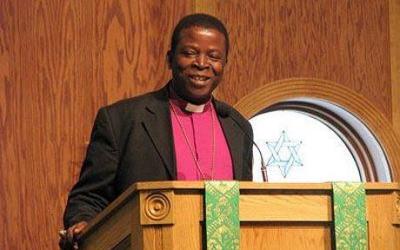
    As the Anglican Communion faces the looming threat of schism, the Church of Nigeria finds itself courted by both sides.

    By William Clarke.

    With 18 million members The Church of Nigeria is the Anglican Communion’s second largest province after the Church of England itself, and its fastest growing one. It boasts the President of Nigeria, Goodluck Jonathan, among its congregation. However, the relationship between the Nigerian Primates and their mother Church has not lately been a happy one.

    The opposition of Nigerian Bishops and their congregations to any softening of attitudes towards homosexuality has made them increasingly uneasy with the notion of being in full communion with overseas churches which allow – in their view – an unacceptable latitude in sexual matters. The size and faithfulness of this province means that in any ensuing schism, to be able to claim communion with the Church of Nigeria will be invaluable for a body seeking to present itself as the genuine inheritor of the Anglican tradition. As British, Australian and North American churches fight within themselves over the status of women Bishops and active homosexual clergy, the Church of Nigeria, along with the other African provinces such as South Africa, Tanzania and Uganda, finds itself courted by traditionalists and reformists, Anglo Catholics and Evangelicals, as a fountain of legitimacy for whatever schismatic or unifying agency can claim it. In an extraordinary moment of thwarted ecumenicism the low church, evangelical, and frequently anti-Catholic African Anglicans even found themselves rejecting an advance by Pope Benedict XVI, who wanted to bring them into his newly formed Personal Ordinariate, where they would have been permitted exceptional latitude in liturgy and practice, including the ordination of married men.

    The irony of this is that the Church of Nigeria itself is relatively untroubled by internal dissent. The old debates between Anglo Catholicism and Evangelism which wracked British and North American Churches in the 19th century barely touched the African Provinces, where Anglicanism was always defined by its distance from both the Catholic Church on one side and the Baptist and Pentecostalist movements on the other. In the 20th century the Church seemed contentedly traditionalist on the ordination of women (which they do neither practice themselves, nor oppose in other Anglicans) and collectively conservative in sexual matters. This relative theological unity owes much to the Church’s rapid growth through the 1990s, which means that many of its members are converts, prepared to take Nigerian Anglicanism as they find it. In addition, the issue of homosexuality is unlikely to prove a pisive one in socially conservative Southern Nigeria.

    It has been, however, this social conservatism that more latitudinarian Churches in North America have been troubled by. No-one has ever expected the Nigerians to ordain active homosexuals in the forseeable future, when even the Church of England pays lip service to Issues in Human Sexuality, a statement by the General Synod that requires the clergy to be celibate or married. However, considerable unease has been caused by the former Primate of the Church, and Bishop of Abuja, Peter Akinola. In 2006 the Committee of the Church of Nigeria, headed by Akinola, issued a statementcommending a bill which would see homosexuality punishable by up to 5 years in prison. Three years before, the Episcopal Church in America had consecrated the practising homosexual Gene Robinson as Bishop of New Hampshire. These radical departures threaten the delicate line that the Archbishop of Canterbury, Dr. Rowan Williams, and other unifying forces in the Lambeth Conference, have always tried to walk: demanding heterosexuality and celibacy in Anglican clergy while attacking homophobia and the persecution of gays by national governments.

    These were the pisions that wracked the communion during the lead up to the 2008 Lambeth Conference. Bishop Robinson was not invited to attend, but even so the Primates of four African churches – Nigeria, Uganda, Kenya and Rwanda – as well as a number of other traditionalist Bishops and high ranking clergyman, boycotted the ceremony. The reason given for this refusal was an unwillingness to share communion with, or receive it from, clergyman who held what they view as heterodox and immoral views. This claim has little grounding in mainstream Anglican Eucharistic theology, with the 26th Article of Religion explicitly separating the worthiness of the sacrament from that of the minister providing it. The boycott was instead seen as a statement of dissatisfaction with the direction of the Anglican Communion, and a possible desire of the four Provinces to remove themselves from it. A month before the Lambeth Conference the African Primates met with other discontented clergy in Jerusalem, for the seven day Global Anglican Future Conference (GAFCon). The conference hoped to bring together Anglican clergy unhappy with the direction of the communion on a number of theological issues, but the main issue under discussion was that of the American Episcopal church and its pergent stance on homosexuality. It is to the GAFCon, rather than to Lambeth, that the Church of Nigeria declared their allegiance when rebuffing the Vatican’s advances last year, and it seems that Nigerian Anglicans, as well as those in Uganda, have comprehensively rejected Rowan William’s attempts at compromise.

    However, whatever one’s views on the ordination of homosexuals, there are very good reasons to be wary of GAFCon and its future. The Reverend Doctor Mouneer Anis, the Bishop of Egypt and presiding Bishop of Jerusalem and the Middle East, a doctrinal conservative and member of the Global South grouping whose steering comitee Peter Akinola chairs, warned that the ‘Global South must not be driven by an exclusively Northern agenda or Northern personalities. The meeting of the Global South in ’09 will be critical for the future, and the agenda will need careful preparation ahead of time.’ It is certainly true that GAFCon, which depends for much of its legitimacy on the huge memberships of its African Churches, saw a great deal of its agenda set by the majority of British, Australian and North American clergy who made up its leadership council. The main achievement of the conference was the establishment of the Fellowship of Confessing Anglicans, a grouping of traditionalist churches which will have little impact in unified Nigeria but a great significance in the pided north. It is hard to see how practice or worship will be altered for Nigerian Anglicans, but impossible to deny the significance for the schismatic Anglican Church in North America, which is now in full communion with the Church of Nigeria.

    Nigeria now exists in an uneasy union with the Anglican communion. At GAFCon, former Nigerian Primate Peter Akinola stressed his desire to avoid schism, stressing “we have no place to go, nor is it our intention to start another church” , but the Church has made clear it considers itself in more perfect communion with the Anglican Church in North America than the Episcopal Churches of the United States and Canada. However, the complexities of Anglican ecumenicism is of little importance to congregations in Nigeria. The real significance of the Church of Nigeria’s relationship with its sister churches will be felt far outside its own borders, among congregations in Europe, America and Australia for whom the support of Anglicanism’s second largest province would confer legitimacy on whatever segment of the fracturing Communion they belong to.
  • in

    Nigerian Elections 2011: Goodluck May Need to Live up to His Name

    After being tagged as favourite to win Nigeria’s presidential elections, Goodluck Jonathan’s campaign is faltering – despite the help of American strategists.

    By Mark Dearn

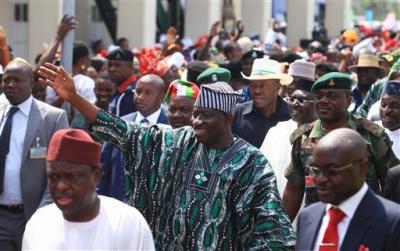
    President Goodluck Jonathan on the campaign trail

    It was through the death of Umaru Yar’Adua that “accidental president” Goodluck Jonathan became Nigeria’s head of state. And with a faltering campaign marred by low turnouts on the campaign trail further buffeted by prominent figures rallying behind what may become an opposition running on a joint ticket, the former overwhelming favourite may now need to live up to his name to retain office.

    Former Minister of the Federal Capital Territory Nasir Ahmad El-Rufai told Think Africa Press that “it is unlikely that Jonathan will score 25% of the votes cast in enough of the 19 states to be a serious contender for the presidency”. In recent days Jonathan has also been hit by a series of broadsides which threaten to derail his campaign targeted at Nigeria’s burgeoning urban youth, and supported by American strategists from Trippi & Associates – who Think Africa Press can reveal are on the ground in Abuja.

    Taking damage

    First, former military ruler Gen. Ibrahim Babangida backed the bid for the presidency by Action Congress of Nigeria (ACN) candidate and former anti-corruption csar, Mallam Nuhu Ribadu. Babangida – whom Jonathan has said is “like a father” to him – stated that Nigeria is in need of a more youthful leader than Jonathan, arguing that “We have to allow generational change, which the ACN candidate represents”. And in a report attributed to well-positioned sources, it has been claimed that main opposition candidates Gen. Muhammadu Buhari of the Congress for Progressive Change (CPC) and Ribadu are to join forces and, after the outcome of this weekend’s National Assembly elections, decide who will stand as a unified opposition candidate against Jonathan.

    Former president Olusegan Obasanjo reportedly left Jonathan “shocked” and “taken aback” after his final rally in Eagle Square, Abuja, when he said that zoning is enshrined in the PDP constitution – Jonathan controversially ignored the issue of presidential rotation between Muslims and Christians when he contravened the zoning pact by running for office. The issue is a key concern in winning the 58% of votes in the north of the country that could be crucial to a first round victory, and its resurfacing at the end of the campaign will do Jonathan no favours.

    Jonathan has reiterated his hope for a clean election that would break from the legacy of the highly flawed polls recorded since 1999’s re-democratisation. However, the day before Jonathan stated that “nobody must manipulate votes in my favour”, Independent National Election Commission (INEC) chair Prof Attahiru Jega revealed that “several” high profile individuals registered more than once for voting. Jega opted against releasing the names, but the ACN claimed the culprits were most likely PDP members. The pursuit of a clean election was further hit when a Resident Electoral Commisioner in Anambra State told the press last week that he is under pressure to rig, claiming “My refusal to do the bidding of politicians has elicited malicious reactions from politicians”.

    All this comes on the back of damaging allegations from Wikileaks and PDP rival and party founding member, Atiku Abubakar. Abubakar, a former vice-president, called on INEC to rule Jonathan’s victory against him in the primaries illegitimate after claiming Jonathan bribed delegates with $7,000 each to secure their votes, adding that Jonathan’s selection in place of a Northern candidate risked plunging the country into “lawlessness and anarchy”. Wikileaks claimed that Speaker of the House of Representatives Dimeji Bankole was reported to have told the US Ambassador that Supreme Court justices were bribed by a state governor to ensure victory for Yar’Adua and Jonathan in 2007, while Edo State governor Adams OShiomole was reported to have told US officials that Jonathan voted four times. Oshiomole denies ever making the claim and Jonathan has threatened to sue the publishing newspaper.

    The “Facebook President”

    While Nigerian elections historically favour incumbent presidents and the PDP has returned presidents in every election since the country’s re-democratisation in 1999, Jonathan none the less pulled out all the stops to carve out an innovative campaign to attract the votes of the some 40 million youths who account for the majority of the 73 million registered voters.

    Much has been made of Jonathan’s presence on Facebook, where his tally of 500,000 “fans” is only surpassed by one other politician – Barack Obama. Jonathan’s staff have trumpeted that his engagement with Facebook and Twitter and use of voicemail on mobile phones is introducing a new dynamic between leaders and voters. In this they have been joined by Joe Trippi, the Democrat Party strategist who worked on the campaigns of several US politicians and also supported then ACP candidate Atiku Abubakar in 2007.

    Trippi, who has had staff in Abuja assisting the Jonathan campaign for more than a week, argues that Jonathan launched his Facebook page to“deepen engagement with Nigerians and connect directly with citizens”. In an article published by the Huffington Post, Trippi says that Jonathan is “aggressively” trying to ensure elections will be free and fair, that he has already “shed much of the patronage politics that has plagued Nigeria’s young democracy”, and that his setting up and interacting with his Facebook page shows that Jonathan “understands that he holds his office to serve the will of the people”.

    While Jonathan strives to give the impression that a clean election is of paramount importance to him, although he appointed the widely respected Prof Jega to INEC he has failed to instigate a reform of the rest of the organisation, did not relinquish his power to appoint or remove INEC chiefs, and did not remove INEC’s dependence on presidential funding. Trippi’s assertions about the withering of patronage politics are even more specious. Nasir Ahmad El-Rufai of the Good Governance Group (3G), a former head of Nigeria’s privatization agency, and a former ally of Ribadu and critic of the Jonathan presidency, told Think Africa Press that embedded patronage will play a key role in garnering votes.

    Losing votes

    El-Rufai said that, in his view, Jonathan will struggle to win the election with ease.

    “Most of those that would vote for Jonathan are either from his part of the country or direct beneficiaries of the intensively rentier structure that has become the Nigerian state under Yar’Adua and Jonathan,” he said.

    “The bulk of Northern voters are simply upset with him for denying and defying the PDP “zoning” arrangement already embedded in the Party Constitution.

    “Many others, particularly in the South-West and South-East, will not vote for Jonathan because he comes across as an uninspiring, weak and incapable leader. In his 12 months or so in the saddle, the nation’s economy has been pushed to near distress – the Excess Crude Revenues Account has been frittered away, reserves have gone amidst rising oil prices, and fiscal indiscipline has been high. Insecurity levels have risen all across the nation without any adequate response.”

    Indicative of the malaise El-Rufai points to is the Excess Crude Account, which functions as a stabilization fund filled with money from oil revenues. Although funds from it have been used for boosting electricity generation and providing stimulus for the economy, some $22 billion was unaccounted for by February this year, with the money believed to have been withdrawn by state governments: earlier in the year, Jonathan approved the sharing of some $2 billion for states due to their support of his presidency. A financial consultant who has advised the Nigerian government told the New York Times: “It’s basically free money. Once you get it, there are no checks and balances on what happens to it.

    To rig, or not to rig

    Since Jonathan’s chances of winning are now no longer quite as certain as had previously been thought, attention will focus on INEC’s role in insuring a clean election and perceived attempts at rigging by the PDP. The combination of an escalation in inter-ethnic violence over the past year and Jonathan’s contravention of the zoning pact mean that any perception from Northerners that the South has rigged an election to retain power could be met with violence and a national crisis.

    One of Nigeria’s most prominent human rights lawyers, Femi Falana, has hinted that action on the streets may be the best option in the case of a stolen election.

    “If expectations of Nigerians concerning a credible poll in April are not met, I am very convinced that the crisis that will come up will not be solved in any law court but on the streets,” he said. “People should guard their votes jealously and ensure that their votes are not stolen by those who are bent on keeping them in bondage forever.”

    There will be many in Nigeria and beyond who will be hoping Falana’s predictions will not be put to the test.

  • in

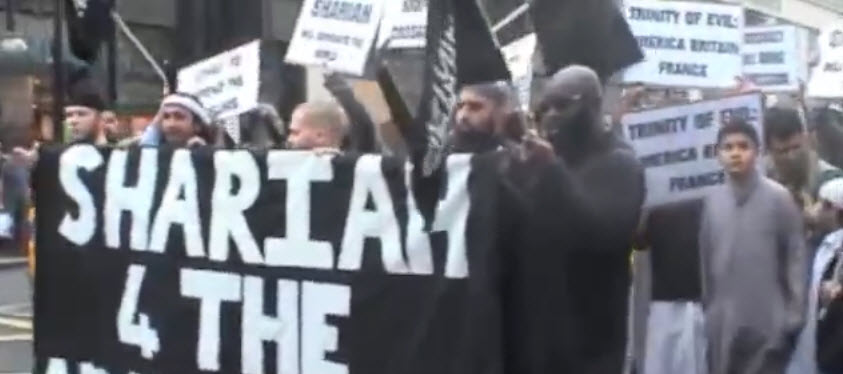
    Sharia Law for Libya Protest Shuts Down Oxford Street, London

    A protest march against allied action in Libya hit central London, 25th March 2011

    A protest march against allied action in Libya hit central London today, Friday.Dressed in black and white, supporters of Sharia law chanted claims that Sharia law is the only option, not only for Libya, but for the West as well. A spokesman for the demonstrators – who nationality is unknown – referred to the “changing tides of the world”: for the demonstrators, events in North Africa are indicative of something more than the expulsion of dictators.

  • in

    Gacaca Highlights Failure to Deal with RPF Crimes

    In the first of a three-part interview, Dr Phil Clark talks to Think Africa Press about transitional justice in Rwanda, Uganda, Congo and South Sudan.

    By Chris Stefanowicz

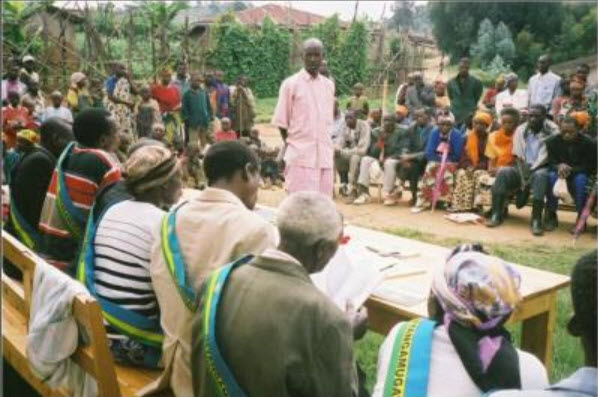
    A man gives evidence to a gacaca court in Rwanda.

    How do you think that the failure of the gacaca courts to address the crimes of the Rwandan Patriotic Front (RPF) – after taking Kigali in 1994 and also later in the DRC – will affect longer-term stability and reconciliation in Rwanda?

    I think this failure to deal with RPF crimes is one of the biggest problems that the gacaca process has brought up. It’s not talked about a lot in the literature on gacaca, but the population discusses RPF crimes explicitly during many gacaca trials. You have an RPF government, which is obviously very worried about people talking about RPF crimes in open spaces. But, especially on the periphery of Rwanda, gacaca has created a space where the population regularly talks about RPF crimes in a very public and comprehensive way. This is quite revolutionary in terms of Rwandan politics. The problem is that as people have talked about these crimes openly, there has been an expectation or a hope that gacaca would also prosecute RPF crimes – and that hasn’t happened. A great deal of frustration has been borne out by this process. It means that, in the long term, gacaca hasn’t delivered even-handed justice. It has been very comprehensive in terms of dealing with genocide crimes but has, in a prosecutorial sense, not dealt with the other side of the equation. This is a running sore for the Hutu majority, and the legacy of it will be that much of the Hutu population will look back on gacaca and see it as one-sided justice. In my opinion, there is no doubt that this will harm the long-term cause of reconciliation. This isn’t to equate genocide crimes and RPF crimes in moral terms – I think there is an important normative distinction between genocide and crimes committed in revenge following genocide – but the failure to address the latter is nonetheless problematic.

    How exactly are gacaca judges supposed to deal with these issues when they arise? According to the Gacaca Law, when crimes committed by the RPF come up during trials, how are judges supposed to treat them as evidence, especially in their final judgments?

    The Gacaca Law is quite strict in terms of the types of crimes that can be prosecuted through gacaca. There is an emphasis on genocide crimes, which are strictly defined to ensure that gacaca does not prosecute RPF crimes. The nature of the atrocities and also the timing of those crimes in the Law ensure that RPF atrocities are almost never formally brought to the courts as criminal cases. It is left to the judges to use their own discretion in terms of how they deal with RPF cases if they arise in community discussions. Most judges know fully well how opposed the government is to looking at these particular crimes. What judges tend to do is tolerate the open discussion without actively encouraging it. They tend not to record that evidence once the trial is finished because, of course, judges are concerned that if they transfer the transcripts of the trials back to central authorities and it becomes known that they have allowed open discussions of RPF crimes then they themselves could get into trouble. What goes on during gacaca trials is a reasonably well-hidden secret in a lot of communities.

    You get a sense from the human rights literature on gacaca that the process is nothing more than an attempt by a draconian government to control the entire country. Gacaca is usually talked about these days as a tool of centralised power and an attempt to subjugate the Hutu majority. But, particularly in communities on the fringes of the country, gacaca has actually become much less predictable than that. The government may have had certain intentions when it created this justice process – and even those intentions were highly varied – but once it got rolled out to the entire country, communities started to take ownership of the process in ways that the government may not necessarily have agreed with. Pockets of resistance emerge as the process unfolds – it is an important development that most commentators on gacaca have completely overlooked. One of the reasons for that is that a lot of the commentary on gacaca tends to focus on communities very close to Kigali, and tends to focus only on state agency rather than popular actions within the confines of the state. But some of the more interesting developments have happened in places far flung from the capital where state influence decreases.

    In the areas adjacent to the Kivu regions of the DRC, places like Gisenyi and Ruhengeri?

    Yes, in the northern borderland jurisdictions and also in the far South, in communities where there is less of a government presence at gacaca meetings. It is true that the Rwandan state is heavily centralised, but it is also a very limited state in terms of resources and so it cannot extend its influence into all places at all times. There are some very important regional differences in the way in which this trial process has unfolded. Closer to Kigali, both judges and the population are very careful about what they say. You see a greater physical presence of government officials in those communities. On the fringes of the country the community is often much freer to talk in a way that people closer to the capital are not. There is a great diversity of communities that have very different experiences of gacaca.

    In those peripheries where open discussion is more necessary for the community – and hence more tolerated by judges – have the strictures placed on the judges when recording the evidence from a case affected their moral authority?

    They haven’t because the bulk of the population understands the rules of the game. There is an understanding among most participants in gacaca, as well as among the judges, that recording this evidence would create problems for everybody. Typically there is a sense among the general population that actually the judges are doing them a favour by not recording these things. The purpose of people talking about RPF crimes outwardly is really not so much to send a message to central authorities – because people could get into trouble for that – it is more to articulate a concern within the community itself. For many years people have not been able to talk about these things openly. Gacaca has created a space where at least a community conversation on these issues is possible now.

    Now I don’t want to overstate how many communities permit this kind of discourse. I have looked at gacaca in around 20 communities in five different provinces over a period of eight years, and out of those 20 communities these crimes are talked about regularly in 20 or 25% of those. It is certainly not in a majority of places. But it is a significant enough trend to suggest that some important and unexpected things have been going on within the gacaca framework.

    Does this mean that the UN Mapping Report – both when it was leaked and when it was released officially – did not really affect the internal machinations of the courts and what the populace already knew? Has its primary effect been on the RPF government by changing the terms of engagement with the international community?

    The UN Mapping Report didn’t tell the Rwandan population anything it didn’t already know. Nonetheless the Report has been very damaging to the Rwandan government because it relies so heavily on a good international reputation. One of the bases of the RPF’s power in the last ten or 15 years has been unswerving support by the UN, the US and the UK in particular. They are the major backers. Their support has meant that the Rwandan state could do almost anything in the knowledge that those parties were in the background supporting it. The UN Mapping Report is damaging in that regard.

    However, the report itself is problematic for numerous reasons, and there is a growing sense of critique of the report, particularly in terms of its methodologies. The threshold of evidence for many of the report’s claims is very, very low. Really, there is no difference between the standard of evidence required by the report and that required by a journalist operating in the region. To my mind, that is not good enough given the UN expertise that was available and the political ramifications of a report like this. The fact that the report uses the term ‘genocide’ at all requires it to have used a very high threshold of evidence – and it has not done that. The report is much sketchier than a lot of people have recognised, and I think the Rwandan government has a legitimate claim when it points this out. But nevertheless the fact that the report has been disseminated as widely as it has, and that the UN is standing by it, does cause major political fallout for Rwanda.

  • in

    Resurgent Islamists Threaten War in Nigeria

    Think Africa Press examines whether Boko Haram’s alleged involvement in a politician’s assassination could create chaos in Plateau State.

    Article | 7 February 2011 – 3:08pm | By Alex Thurston

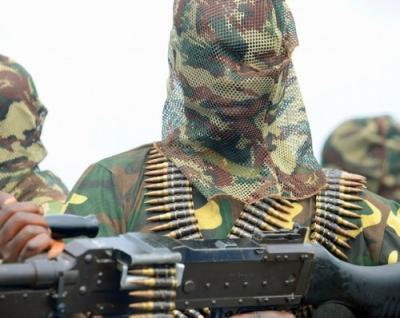
    Last week, the Islamic movement Boko Haram threatened the Nigerian government with a “full scale war.” Boko Haram’s mass uprisings and targeted killings have sometimes shaken state control in Nigeria’s northeast. With Nigerian security forces struggling to manage Muslim-Christian conflict elsewhere in the country, an escalation of Boko Haram’s activities between now and April’s elections could pose serious problems for the government.

    Boko Haram’s name translates as “Western education is religiously forbidden.” The group also asserts that only an Islamic state can be legitimate. This ideology has justified their assaults on the representatives and institutions of the Nigerian government.

    The group came to public view in July 2009, when it took revenge for the arrest of several of its members by attacking police stations in Maiduguri, the capital of Borno State. Hundreds died in the ensuing conflict before the Nigerian army smashed Boko Haram. The movement’s leader, the preacher Muhammad Yusuf, died in custody, and Boko Haram faded away for a time. But in September 2010, Boko Haram freed scores of imprisoned militants in a jailbreak.

    Since then, teams of Boko Haram gunmen on motorcycles have killed dozens in Maiduguri. Assassinations have targeted police officers, rival clerics, and – if the group’s latest statement can be believed – major politicians. According to posters that appeared this week in Maiduguri, Boko Haram was behind the January 28 shooting of Modu Fannami Gubio, a candidate in April’s gubernatorial election.

    Officials have disputed Boko Haram’s role in the incident, but if Boko Haram did kill Gubio then the murder represents an explicit foray by the movement into electoral violence and shows that they are selecting higher-value targets. Gubio hailed from the All Nigeria People’s Party (ANPP), a national opposition party that currently holds the governor’s seat in Borno State. Gubio was widely expected to win the race, and his death has shaken the political establishment there. Spooked lawmakers have kept the state House of Assembly in adjournment, and politicians are seeking increased security.

    Boko Haram’s murders of policemen have created tension and fear in the northeast, but murders of politicians could throw the region into chaos.

    National authorities acknowledge the threat Boko Haram poses. Inspector-General of Police Hafiz Ringim told his subordinates that Boko Haram and the Muslim-Christian violence in Plateau State are currently the two biggest challenges for security forces. The Vice President has promised quick solutions to both conflicts.

    But will it be possible to manage the crises simultaneously? The conflict in Plateau State, which has claimed some 200 lives since Christmas Eve, is demanding greater and greater involvement from the federal government, including the recent deployment of 870 soldiers.

    With citizens protesting and activists calling for the governor’s resignation and/or the declaration of a state of emergency, violence in Plateau State has caused a political as well as a security crisis. As matters deteriorate there, it could become harder for the federal government to summon the manpower and the political will to put down the unrest in the northeast.

    That is why Boko Haram’s threats of war, which are far from idle, represent such a scary prospect for Nigerian authorities. The situation is already serious. An escalation of violence, with elections just two months away, could be a nightmare.

  • in

    Fighting Off The Vultures

    Liberia’s legal battle against private sector debts, its consequences and the need for reform.

    By Theo Barclay

    http://www.dmitrimarkine.com

    ‘Vulture’ funds buy up defaulted national debt for less than the stated value. By claiming that debt through courts, profit is all but guaranteed: the only barrier is an ethical one. The debt is invariably owed by the world’s poorest governments, so the cost is not merely financial but directly humanitarian. Liberia’s recent experiences with these funds set an alarming precedent that requires consideration.

    In November 2010, the Liberian government concluded a long battle with secretive offshore funds Hamash Investment and Wall Capital, allegedly owned by US financiers Eric Hermann and Michael Straus. The companies had purchased the rights to a $6m loan advanced to Liberia in 1978 by the USA-based Chemical Bank. In 2009 they sued the Liberian government for nearly $20m in the English High Court in the unreported case Hamash Investments v. Liberia. With reluctance, Mr. Justice Burton was forced to order repayment, stating “The only issue raised is plainly a sad one, that Liberia is a poor country, and cannot afford it.”

    This was no exaggeration. Struggling to rebuild following a 14 year civil war that ended in 2003, Liberia is ranked by the IMF as the third poorest country in the world, and at the time of the judgment 80% of the population was surviving on less than $1 a day. The $20m that the funds claimed was twice as much as the 2009 healthcare budget, so the humanitarian costs of enforcing such an old loan were direct. This had not deterred Straus and Hermann, whose disagreeable desire for easy profit was also demonstrated in February 2002. A lawsuit for $18m was filed in New York in the week Liberia’s capital Monrovia was under siege from rebels, without electricity, water or a functioning government. Unsurprisingly, Liberia failed to appear in court and lost by default.

    In the aftermath of the UK case, President Ellen Johnson Sirleaf, Africa’s first female head of state, publicly pleaded with the financiers – “Here’s a country having two decades of turmoil, death and destruction trying to find its way back, trying to give its young people a future. You should not be the one to become an obstacle. Have a conscience and give this country a break’. Liberian diplomat Winston Tubman took a less restrained approach, asking if the financiers realised they were ‘causing babies to die’ all over the nation, and were ‘making it almost impossible for the country to get back on its feet’

    Thankfully the affair reached a slightly more positive resolution. In November 2010, a year after the judgment against them, the Liberian finance minister Augustine Ngafuan announced that, following a ‘David and Goliath’ fight, a deal had been reached with the firms, and that a reduced proportion of the debt would be repaid. This almost certainly still represents a considerable profit for Hermann and Straus. Especially considering legal fees, this profit has only been to the detriment of the Liberian population.

    Distressingly, Liberia’s experience with the ‘vultures’ is far from an isolated incident, and, given the continued existence of vast sums of undeclared African debt, it may set an alarming precedent for future action.

    Many financiers have chosen to handle government debt in a more ethical way, either by striking it off or demanding very low rates of repayment for a small proportion of what is owed. In 2007, $4 billion of Liberia’s debt was waived through the ‘Heavily Indebted Poor Countries Initiative’, including $2 billion from private-sector bondholders. One of those bondholders, Hans Humes, CEO of Greylock Capital, said of Hamash and Wall Capital, who declined to participate in the debt relief scheme, ‘All they’re trying to do is to exploit the system, hold the system hostage, to get some sort of excessive returns’.

    A concerted international effort must be made to eliminate the potential for similar cases in the future. The British Parliament has gone some way towards combating this problem. Andrew Gwynne, the Labour MP for Denton and Reddish, proposed what became the Debt Relief (Developing Countries) Act (2010) through an early day motion. Despite vociferous objection by a small group of Conservative MPs led by Christopher Chope, the Bill was successfully passed. The Act bans ‘vulture’ funds from litigating in the UK courts, eliminating the prospect of a repeat of the Liberia case in Britain.

    However, the jurisdiction from which the claim arises makes scant difference to the victim governments. A full resolution to the problem will require concerted international action, particularly from the USA, as most of the existing third-world private debt is believed to be held by banks based in America.

    There has been an attempt at regulation by the courts, but without success. In 1998, a US judge attempted to punish Michael Straus by invoking the medieval law of ‘champerty’ – encouraging a lawsuit for personal gain. The approach, however, was overturned on appeal.

    The clearest way for the USA to tackle the issue would be through legislation. It is time for Congress to defy their traditional hostility towards regulation and take a harsher stance against the funds. A Bill similar to the UK’s Debt Relief Act would make further action by vulture funds impossible in the two most commonly used jurisdictions, allaying the fears of economically deprived nations that previously unknown debts could be arbitrarily enforced against them.

  • in

    Nanoparticle-Based ontogenetic Modifies Behavior in Mice (brain)

    By employing light to control ion channels on nerves in creature brains, researchers can observe how behavior was changed by manipulating neural circuits in real-time. Since this moment scientists applied the way operate within a variety of species and to review mind, from fresh fruit flies which the method will be examined to successfully replace vision in people having an illness that is rare. Currently (February 8) in Science, scientists conducting ontogenetic experiments using perceptible Nano-particles in mice, bettering the Spot closer to your Non-Invasive Direction of sparking the brain Utilizing mild that can one day possess curative software

    This system needs fibers throughout the past couple of decades, researchers have begun to build methods to arouse mental performance in techniques that are less invasive. Quite a few classes devised such ways with magnetic areas, electric currents, and noise.

     McHugh and his coworkers decided to use a second approach: they chose light, which may readily penetrate tissue. “What we saw being plus had been chemistry-based manner for the reason that individuals can exploit the capacity of near-infrared light to permeate cells, but use the arsenal that’s been invented throughout the prior ten years of ontogenetic channels which answer observable light,” McHugh states. Hence Chen,Healrun,” McHugh, together with side their collaborators devised an approach to conduct ontogenetic stimulation with neon-particles that can transform tissue-penetrating shut infrared light into blue and green foliage (an activity identified as up-conversion ).

    The necessitated two shots under evaluation –one comprising a vector filled with ion stations called ontogenetic, and the nanoparticles being carried by yet another. The project had been pioneered by Shoo Chen, a postdoctoral fellow in McHugh’s laboratory who’d transitioned from chemistry into neuroscience later getting his Ph.D. “At the moment, my question was, how we can perform that type of manipulation of those neural tissues which can be deep in mind at a noninvasive way, rather than implanting neural fibers.”

    Chen and his co-workers examined the exact technique at some of the experiments from the mouse hippocampus. The investigators could alter fear-related behaviors by managing the game of neurons. To begin with, the team analyzed this technique from mice, occurring together with the ventral tegmental area (VTA), a place deep in mind with a large populace of dopaminergic neurons. After injecting nanoparticles and then the vector to the city in anesthetized mice, an infrared light shined above the animals’ heads–and discovered that they could excite dopamine release.

    The procedure, in its present stage, has a few limitations. Because of this,” the forces which can be needed to induce those particles could be rather tricky to supply with a tiny, battery-powered LED,”” Aniela, that wasn’t associated with the analysis, informs The Scientist. (Presently, the source of light isn’t wireless). Also,” acquiring the light into the skill which is expected to enter involved with profound mind structures in more substantial product organisms will likely probably be exceptionally challenging devoid of large [heating],” she says. Stanford University professor who didn’t merely take aside in the newest endeavor, very initial indicated the odds of utilizing the up-conversion of moderate into noninvasive ontogenetic at 2011 together with his previous scholar, Poling Aniela, which contributes the bioelectronics ring at MIT. Still another possible issue, based to Wolfgang Park at the this University of Hamburg who was not associated with the analysis, is the way nanoparticles will manage the plasticity of the individual anatomy. “All cells prefer to add nanoparticles… therefore the rankings

    [of these particles]

    may change [overtime].”

    Watch” Tuning Mental Performance. There are numerous other brain tissue entering techniques which can be utilized to get and control the game of cells, without having a permanently implanted hardware at a mental performance. All efforts to come up with noninvasive DBS for therapeutic purposes have” yet to cope with viability and safety of surface power conditions given the enormously increased measurement of the mental faculties as well as the bark brain,” writes. “We might need to wait and determine which techniques, if any, actually work inside your anatomy; till afterward, or maybe if this never happens, fresh procedures for doing experimental chemistry are always welcome” DBS utilizes an apparatus, and it has been used to successfully take care of a handful of disorders, including epilepsy and Parkinson’s. While Much Many More Compared to 100,000 People Have Been Medicated Utilizing this Specific Process, It Is a Disadvantage –for Example as Employing Traditional ontogenetic, the Very Important Elements (electrodes in Addition to a Heart-beat) need to be implanted into Your Brain

    But, Lozano informs that the Scientist, most of those newer processes require altering mental performance in a particular manner, such like up conversion-based ontogenetic, which is based upon injecting nanoparticles or germs taking genes encoding light-sensitive ion stations into the brain. Just because they require shots to the brain, also,Medihemp, are quite invasive. However, this hurdle could be overcome utilizing an alternative procedure, focused ultrasound, to open the barrier and by sending these molecules. For the time being, the team has been now employed to enhance its technique — by increasing the efficacy of their nanoparticles as well as finally, scaling up to larger creatures, like rats and primates. In this analysis, McHugh claims “measure among the many, lots of measures.

  • in

    Develop A Set-up Routine

    The period between un-racking the hand weight and beginning your set is known as the ‘walkout.’ A regular oversight is investing excessively energy here, Ketozin, rearranging your feet around all while supporting a stacked free weight over your upper back. Once you’ve un-racked the free weight, give yourself three stages to get into position. Turn this into daily practice and approach each set similarly. The most effective method to Barbell Back Squat: The Movement Pause for a minute keeping your abdominal area supported and strain in your legs.

    The Movement: Trainer Tips

    A well-known rule for the scope of movement (how far you can move amid an activity) is to squat until the point that your hamstrings contact your calves, something regularly alluded to as hunching down ‘ass to grass’. In any case, this is an over speculation and not explicit to you as a person. There is a general, specialized model for the hand weight back squat which we’ve got a plot in this guide, yet what this looks like by and by will shift somewhat between people dependent on individual contrasts in hip life systems and appendage length proportions. You have achieved the finish of your scope of movement when you can’t squat any lower without your hips beginning to ‘tuck under’ or ‘butt wink.’ Past this point, any extra range will originate from flexion of your spine (a specialized term for your lower back rounding). If you will likely form the significant muscles gatherings of the lower body (quadriceps,  glutes, and hamstrings) while keeping up a sound lower back, at that point, there is no advantage to surpassing your scope of movement. Before beginning your exercise, we prescribe playing out a particular get ready to help decide reaches of change for sheltered and compelling preparing. Begin with an emptied free weight and dynamically increment the heap with each warm-up set. You can likewise video record yourself playing out a game or ask a preparation accomplice/proficient coach to help distinguish the end-purpose of your scope of movement.

    Utilize Simple But Effective Performance Cues

    Signals are a kind of guidance we offer customers to encourage instruct and fortify legitimate exercise technique. A powerful verbal prompt takes a muddled arrangement of activities and communicates it in a primary and straightforward to pursue manner. Throughout the development, take a stab at concentrating on pulling down on the hand weight as though you were attempting to twist it over your upper back. Furthermore, when you hit a ‘staying indicate,’ a fast update ‘twist the bar’ can assist you with maintaining appropriate procedure and push through that part of the movement. A basic system warning with the hand weight back squat is the point at which someone’s hips are the principal thing to lift while changing from the base position into the upward development. A straightforward signal to help fix this is to concentrate on ‘chest goes first’ when driving out of the base position. You can likewise take a stab at concentrating on keeping the separation between your hips and shoulders rise to all through the whole movement.

    Hold Your Breath

    To make however much strain as could be expected in your abdominal area, bring a significant breath down into your stomach before you begin your plummet and after that bolt your abs tight as though you were propping for a punch. The specific term for this is ‘supporting.’ When you’ve taken a major breath and set your support, hold it for the whole development. Right down, the whole distance back up. No air should get away from your lips. Check out our activity video library for video exhibits of the above tasks. Subsequently, your preparation objectives will go far to deciding the correct rep go for you. When you first begin crouching, we prescribe adhering to the 6-12 rep extend. Before bringing the hand weight back squat into your preparation program, we prescribe concentrating on activities with shallower expectations to absorb information that objective similar muscle gatherings and enable you to create abilities that will extend to the hand weight back squat. If you’ve never back crouched or are new to preparing by and large, at that point center around primary activities like the progression up, split squat and leg press for 10-12 weeks before presenting the hand weight back squat.

    Exercise Order and Pairings

     Paired sets: A kind of activity matching, where you play two activities in substituting style, separated by a correctly estimated rest period. Matching practices together and shifting back and forth between the two can be an effective method to prepare, yet you should know about target muscle assemble overlap. To limit any effect on your performance, we suggest blending the free weight back squat with a leg twist or abdominal area squeezing development, for example, the free weight seat press. However, if you will likely lift the most measure of weight conceivable, and you have room schedule-wise to extra, Healrun, at that point take a stab at utilizing straight sets.

Load More
Congratulations. You've reached the end of the internet.
Back to Top